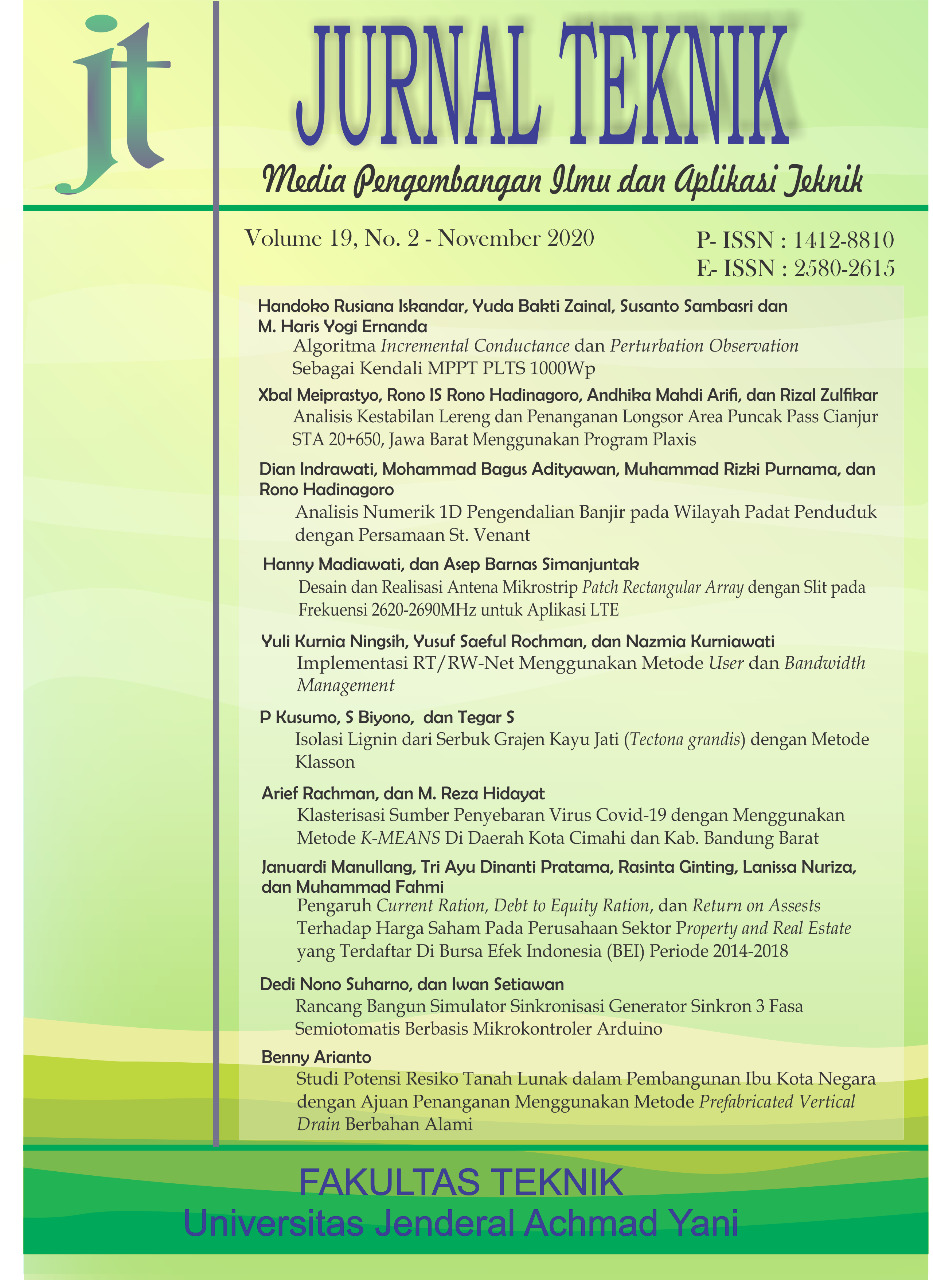
Implementasi RT/RW-Net Menggunakan Metode User dan Bandwidth Management
DOI:
https://doi.org/10.26874/jt.vol19no02.305Keywords:
Internet, Router, Bandwidth, QuotaAbstract
In this paper RT / RW-Net has been designed and realized as a system to access the internet network. The system was built using the Mikrotik Router as an operating system, access point as a network distributor, and an omnidirectional antenna as transmitter and receiver of Wi-Fi signals. The user manager feature on the proxy plays a role in managing several functions such as bandwidth limitation and quota limitation. Quotas and grace periods can be made according to customer requests. The network is tested when the customer is connected to the RT / RW-Net hotspot automatically on the customer's device the RT / RW-Net page will appear to enter the username and password that has been given by the administrator. The system is tested by measuring the RSSI value (Receive Signal Strength Indicator) to determine signal quality based on applicable standards. Based on the test results, the lowest RSSI value is -65 dBm at a distance of 280m to the west with a note that there is no obstacle in the omnidirectional antenna to the customer's device. This system can also inform the remaining quota status and active period to the customer on the RT / RW-Net homepage.
References
Arianto, T. (2009). Implementasi Wireless Local Area Network dalam RT/RW Net. Jurnal Teknologi Informasi DINAMIK Volume XIV No. 2, 152-157.
Cahyo, F. N. (2014). Rancang Bangun Rt/Rw-Net Hotspot Sistem Dengan Mikrotik Router Os Sebagai Manajemen Billing. Semarang: Sekolah Tinggi Elektronika dan Komputer.
Hariswara, B. I., & Kurniawan, C. (2018). Pembangunan Jaringan Rt-Rw Net Berbasis Mikrotik Di Desa Sukodono Kecamatan Dampit Kabupaten Malang. Malang: Sekolah Tinggi Teknik Malang.
Herawati, M. S., Nurasiah, N., & Dewananda, R. I. (2014). Jaringan Rt/Rw-Net Dengan Koneksi Lan Di Perumahan Puri Nirwana 2 Bogor. UG Journal.
Malgaonkar, S., Patil, R., Rai, A., & Singh, A. (2017). Research on Wi-Fi Security Protocols. International Journal of Computer Applications Volume 164 No. 3, 30-36.
Mitchell, B. (2019, 11 12). Achieve 300 Mbps Speeds on an 802.11n Network. Retrieved 10 09, 2020, from Lifewire: https://www.lifewire.com/get-300-mbps-speed-on-802-11n-network-818267
Nurcahya, E. D., & Desriyani, D. (2016). Membangun Layanan Kampung Internet Sebagai Alternatif Usaha Bagi Lulusan Sekolah Menengah Kejuruan. Seminar Nasional dan Gelar Produk (SeNasPro) 2016. Malang: Universitas Muhammadiyah Malang.
Nwabueze, C. (2010). Broadband Wireless Network Technologies: Current Performance. International Journal of Electrical and Electronic Engineering, Volume 2, Number1, 159-165.
Ruslan, R. (2019). Kecamatan Margasih Dalam Angka. Bandung: Badan Pusat Statistik Kabupaten Bandung.
Talika, F. T. (2016). Manfaat Internet Sebagai Media Komunikasi Bagi Remaja Di Desa Air Mangga Kecamatan Laiwui Kabupaten Halmahera Selatan. Acta Diurna Komunikasi Vol 5 No. 1.
Zein, B. (2020, 3 5). Menuju Indonesia 4.0: pentingnya memperkuat infrastruktur dan kecakapan memakai internet. Retrieved from The Conversation: https://theconversation.com/menuju-indonesia-4-0-pentingnya-memperkuat-infrastruktur-dan-kecakapan-memakai-internet-112870
Additional Files
Published
Issue
Section
License
Copyright (c) 2020 Yuli Kurnia Ningsih, Yusuf Saeful Rochman, Nazmia Kurniawati

This work is licensed under a Creative Commons Attribution 4.0 International License.
Authors retain copyright and grant Jurnal Teknik: Media Pengembangan Ilmu dan Aplikasi Teknik the right of first publication. Articles are published open access under the Creative Commons Attribution 4.0 International License (CC BY 4.0), which permits use, sharing, adaptation, distribution, and reproduction in any medium or format, for any purpose, provided that appropriate credit is given to the original authors and source, a link to the license is provided, and any changes are indicated.