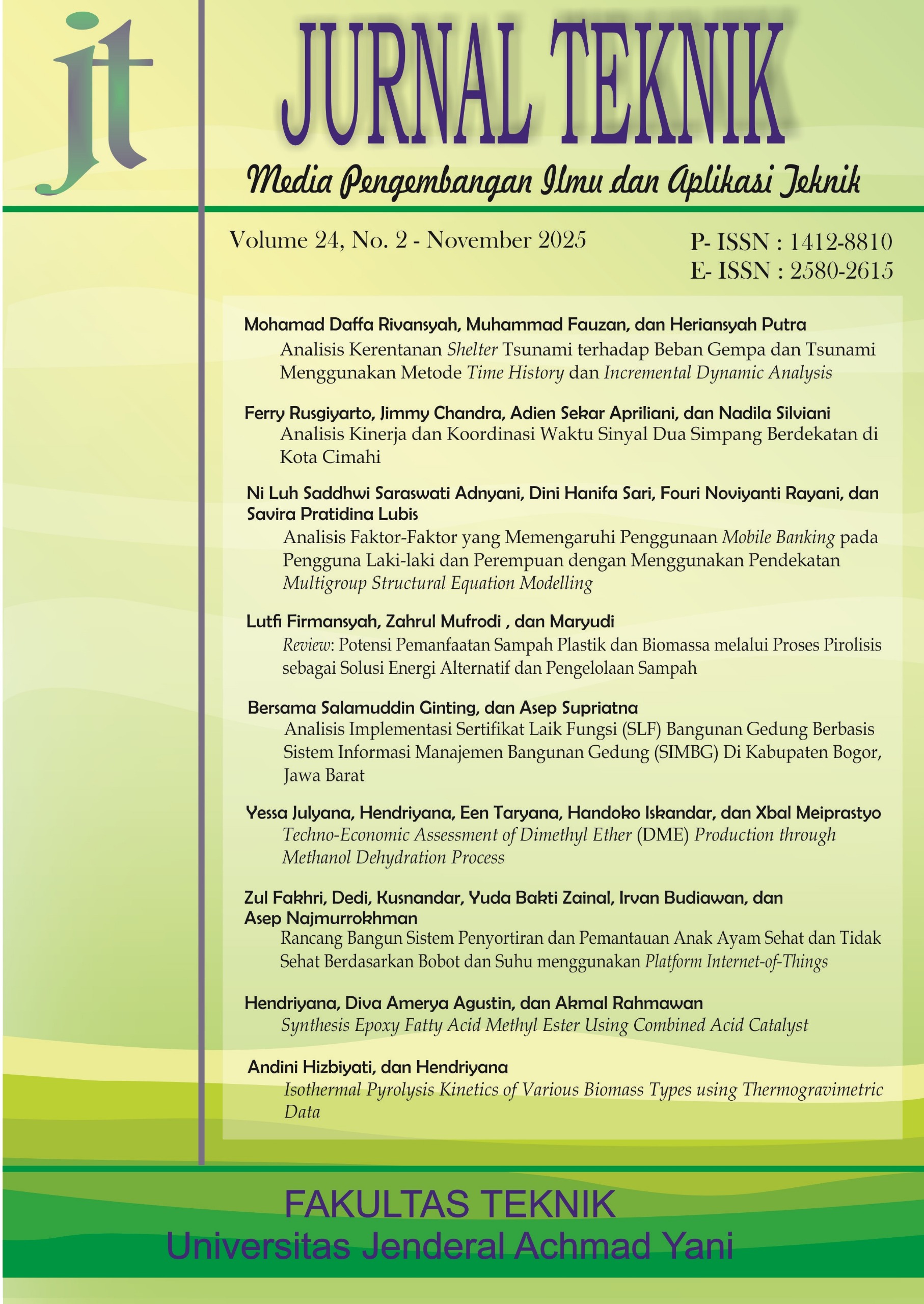
Analisis Faktor-Faktor yang Memengaruhi Penggunaan Mobile Banking pada Pengguna Laki-laki dan Perempuan dengan Menggunakan Pendekatan Multigroup Structural Equation Modelling
DOI:
https://doi.org/10.55893/jt.vol24no2.630Kata Kunci:
SEM, multigroup, gender, adopsi, mobile bankingAbstrak
Mobile banking (m-banking) memungkinkan layanan keuangan diakses dengan lebih mudah. Pada beberapa penelitian ditemukan adanya perbedaan keputusan penerimaan teknologi antara laki-laki dari perempuan. Penelitian ini dilakukan untuk menganalisis faktor-faktor yang memengaruhi penggunaan mobile banking pada pengguna laki-laki dan perempuan dengan menggunakan pendekatan multigroup structural equation modeling (SEM). Terdapat tujuh faktor atau variabel laten yang digunakan dalam penelitian ini yaitu word of mouth (WOM), perceived ease of use (PEOU), perceived usefulness (PU), trust (TR), attitude toward using (ATU), intention to use (ITU), dan actual use (AU). Berdasarkan pengujian yang dilakukan dengan menggunakan 440 data responden, dapat diketahui bahwa pada pengguna laki-laki dan perempuan terdapat perbedaan hubungan antara WOM dengan TR, PU, ATU, ITU; PEOU dengan PU; PU dengan ATU dan ITU; serta ITU dengan AU. Penelitian ini memberikan bukti tambahan mengenai adanya perbedaan gender dalam penerimaan dan penggunaan teknologi, khususnya mobile banking. Selain itu, pada penelitian ini ditemukan bahwa WOM cukup berpengaruh pada adopsi mobile banking, oleh karena itu pada penelitian selanjutnya sebaiknya dilakukan identifikasi faktor-faktor yang dapat mempengaruhi WOM customer layanan mobile banking.
Referensi
Abdennebi, H. B. (2023). M-banking adoption from the developing countries perspective: A mediated model. Digital Business, 3(2), 100065.
Abu-Taieh, E. M., AlHadid, I., Abu-Tayeh, S., Masa'deh, R., Alkhawaldeh, R. S., Khwaldeh, S., and Alrowwad, A. (2022). Continued intention to use of m-banking in Jordan by integrating UTAUT, TPB, TAM and service quality with ML. Journal of Open Innovation: Technology, Market, and Complexity, 8(3), 120.
Alrawad, M., Lutfi, A., Alyatama, S., Al Khattab, A., Alsoboa, S. S., Almaiah, M. A., Ramadan, M. H., Arafa, H. M., Ahmed, N. A., Alsyouf, A., and Al-Khasawneh, A. L. (2023). Assessing customers perception of online shopping risks: A structural equation modeling-based multigroup analysis. Journal of Retailing and Consumer Services, 71, 103188.
Badiang, A. M., and Nkwei, E. S. (2024). Mobile banking adoption, its antecedents and post-adoption effects: The role of consumers status orientation in an African context. Cogent Business and Management, 11(1).
Bagozzi, R. P. (1992). The self-regulation of attitudes, intentions, and behavior. Social Psychology Quarterly, 55(2), 178-204.
Bentler, P. M., and Chou, C. (1987). Practical issues in structural modeling. Sociological Methods and Research, 16(1), 78-117.
Bastari, A., Eliyana, A., Syabarrudin, A., Arief, Z., and Emur, A. P. (2020). Digitalization in banking sector: The role of intrinsic motivation. Heliyon, 6(12).
Birkmeyer, S., Wirtz, B. W., and Langer, P. F. (2021). Determinants of mhealth success: An empirical investigation of the user perspective. International Journal of Information Management, 59, 102351.
Bollen, K. A. (1989). Structural equations with latent variables. New York Department of Sociology: John Wiley and Sons.
Bolodeoku, P. B., Igbinoba, E., Salau, P. O., Chukwudi, C. K., and Idia, S. E. (2022). Perceived usefulness of technology and multiple salient outcomes: The improbable case of oil and gas workers. Heliyon, 8(4).
Cheah, J.-H., Amaro, S., and Roldan, J. L. (2023). Multigroup analysis of more than two groups in PLS-SEM: A review, illustration, and recommendations. Journal of Business Research, 156, 113539.
Davis, F. D. (1989). Perceived usefulness, perceived ease of use, and user acceptance of information technology. MIS Quarterly, 13(3), 319-340.
Davis, F. D. (1993). User acceptance of information technology: System characteristics, user perceptions and behavioral impacts. International Journal of Man-Machine Studies, 38(3), 475-487.
De Canio, F., and Martinelli, E. (2021). EU quality label vs organic food products: A multigroup structural equation modeling to assess consumers intention to buy in light of sustainable motives. Food Research International, 139, 109846.
Hair, J. F., Risher, J. J., Sarstedt, M., and Ringle, C. M. (2019). When to use and how to report the results of PLS-SEM. European Business Review, 31(1), 2-24.
Hair, J. F., Sarstedt, M., Ringle, C. M., and Gudergan, S. P. (2024). Advanced issues in partial least squares structural equation modeling. Sage Publications, Inc.
Ho, J. C., Wu, C.-G., Lee, C.-S., and Pham, T.-T. T. (2020). Factors affecting the behavioral intention to adopt mobile banking: An international comparison. Technology in Society, 63, 101360.
Hutahaean, H. A., Ruwaida, A., Adnyani, N. L. S. S., Govindaraju, R., and Sudirman, I. (2024). Incorporating functional quality into usability model of e-commerce application. TEM Journal, 13(3), 1889-1904.
Imbens, G. W. (2021). Statistical significance, p-values, and the reporting of uncertainty. Journal of Economic Perspectives, 35(3), 157-174.
Ismagilova, E., Slade, E. L., Rana, N. P., and Dwivedi, Y. K. (2019). The effect of electronic word of mouth communications on intention to buy: A meta-analysis. Information Systems Frontiers, 22(5), 1203-1226.
Jebarajakirthy, C., and Shankar, A. (2021). Impact of online convenience on mobile banking adoption intention: A moderated mediation approach. Journal of Retailing and Consumer Services, 58, 102323.
Kim, G., Shin, B., and Lee, H. G. (2009). Understanding dynamics between initial trust and usage intentions of mobile banking. Information Systems Journal, 19(3), 283-311.
Kim, K. K., and Prabhakar, B. (2004). Initial trust and the adoption of B2C e-commerce: The case of internet banking. ACM SIGMIS Database, 35(2), 50-64.
Kline, R. B. (2005). Principles and practice of structural equation modeling (2nd ed.). New York, NY: Guilford Press.
Koenig-Lewis, N., Palmer, A., and Moll, A. (2010). Predicting young consumers take up of mobile banking services. International Journal of Bank Marketing, 28(5), 410-432.
Kroesen, M., Handy, S., and Chorus, C. (2017). Do attitudes cause behavior or vice versa? An alternative conceptualization of the attitude-behavior relationship in travel behavior modeling. Transportation Research Part A: Policy and Practice, 101, 190-202.
Lamberti, G. (2021). Hybrid multigroup partial least squares structural equation modelling: An application to bank employee satisfaction and loyalty. Quality and Quantity, 57(S4), 683-705.
Li, H., and Liu, Y. (2014). Understanding post-adoption behaviors of e-service users in the context of online travel services. Information and Management, 51(8), 1043-1052.
Lin, H. (2011). An empirical investigation of mobile banking adoption: The effect of innovation attributes and knowledge-based trust. International Journal of Information Management, 31(3), 252-260.
Manyanga, W., Makanyeza, C., and Muranda, Z. (2022). The effect of customer experience, customer satisfaction and word of mouth intention on customer loyalty: The moderating role of consumer demographics. Cogent Business and Management, 9(1).
Masrek, M. N., Mohamed, I. S., Daud, N. M., and Omar, N. (2014). Technology trust and mobile banking satisfaction: A case of Malaysian consumers. Procedia - Social and Behavioral Sciences, 129, 53-58.
Mazhar, F., Rizwan, M., Fiaz, U., Ishrat, S., Razzaq, M. S., and Khan, T. N. (2014). An investigation of factors affecting usage and adoption of internet and mobile banking in Pakistan. International Journal of Accounting and Financial Reporting, 4(2), 478.
Mehrad, D., and Mohammadi, S. (2017). Word of mouth impact on the adoption of mobile banking in Iran. Telematics and Informatics, 34(7), 1351-1363.
Morris, M. G., and Dillon, A. (1997). How user perceptions influence software use. IEEE Software, 14(4), 58-65.
Muthen, L. K., and Muthen, B. O. (2002). How to use a Monte Carlo study to decide on sample size and determine power. Structural Equation Modeling: A Multidisciplinary Journal, 9(4), 599-620.
Saparudin, M., Rahayu, A., Hurriyati, R., and Sultan, Mokh. A. (2020). Exploring the role of trust in mobile banking use by Indonesian customers using unified theory of acceptance and usage technology. International Journal of Financial Research, 11(2), 51.
Schierz, P. G., Schilke, O., and Wirtz, B. W. (2010). Understanding consumer acceptance of mobile payment services: An empirical analysis. Electronic Commerce Research and Applications, 9(3), 209-216.
Shaikh, A., and Karjaluoto, H. (2015). Mobile banking adoption: A literature review. Telematics and Informatics, 32(1), 129-142.
Shankar, A., Jebarajakirthy, C., and Ashaduzzaman, M. (2020). How do electronic word of mouth practices contribute to mobile banking adoption? Journal of Retailing and Consumer Services, 52, 101920.
Sharma, M., Banerjee, S., and Paul, J. (2022). Role of social media on mobile banking adoption among consumers. Technological Forecasting and Social Change, 180, 121720.
Sitorus, H. M., Govindaraju, R., Wiratmadja, I., and Sudirman, I. (2019). Examining the role of usability, compatibility and social influence in mobile banking adoption in Indonesia. International Journal of Technology, 10(2), 351.
Sobaih, A. E., and Elshaer, I. A. (2022). Structural equation modeling-based multi-group analysis: Examining the role of gender in the link between entrepreneurship orientation and entrepreneurial intention. Mathematics, 10(20), 3719.
Suh, B., and Han, I. (2002). Effect of trust on customer acceptance of internet banking. Electronic Commerce Research and Applications, 1(3-4), 247-263.
Szajna, B. (1996). Empirical evaluation of the revised technology acceptance model. Management Science, 42(1), 85-92.
Venkatesh, V., and Morris, M. G. (2000). Why do not men ever stop to ask for directions? Gender, social influence, and their role in technology acceptance and usage behavior. MIS Quarterly, 24(1), 115-139.
Wan, W. W., Luk, C., and Chow, C. W. (2005). Customers adoption of banking channels in Hong Kong. International Journal of Bank Marketing, 23(3), 255-272.
Wang, J., and Wang, X. (2012). Structural equation modeling: Applications using Mplus. Chichester: Wiley.
Wu, J., Shen, W., Lin, L., Greenes, R. A., and Bates, D. W. (2007). Testing the technology acceptance model for evaluating healthcare professionals intention to use an adverse event reporting system. International Journal for Quality in Health Care, 20(2), 123-129.
Yang, H., and Yoo, Y. (2004). Its all about attitude: Revisiting the technology acceptance model. Decision Support Systems, 38(1), 19-31.
Unduhan
Diterbitkan
Terbitan
Bagian
Lisensi
Hak Cipta (c) 2025 Ni Luh Saddhwi Saraswati Adnyani, Dini Hanifa Sari, Fouri Noviyanti Rayani, Savira Pratidina Lubis

Artikel ini berlisensiCreative Commons Attribution-NonCommercial-ShareAlike 4.0 International License.
Penulis yang menyerahkan artikel di Jurnal Teknik: Media Pengembangan dan Aplikasi Teknik untuk keperluan publikasi telah mengetahui bahwa Jurnal Teknik: Media Pengembangan dan Aplikasi Teknik memberikan akses terbuka terhadap konten untuk mendukung pertukaran informasi mengenai ilmu pengetahuan, sesuai dengan penerbitan daring yang berbasis Open Access Journal dan mengikuti Creative Commons Attribution 4.0 International License. Sehingga penulis setuju dengan ketentuan-ketentuan berikut:
1. Penulis memegang hak cipta dan memberikan hak publikasi pertama kepada pihak jurnal dengan pekerjaan secara bersamaan
di bawah Creative Commons Attribution 4.0 International License yang memungkinkan orang lain untuk berbagi pekerjaan
dengan pengakuan kepengarangan karya dan publikasi pertama artikel tersebut di Jurnal Teknik: Media Pengembangan dan
Aplikasi Teknik.
2. Penulis dapat melakukan perjanjian tambahan untuk hak distribusi non-eksklusif artikel yang telah diterbitkan di jurnal ini
(misalnya, posting ke sebuah repositori institusi atau menerbitkannya dalam sebuah buku), dengan mengakui bahwa
publikasi pertama dilakukan di Jurnal Teknik: Media Pengembangan dan Aplikasi Teknik.
3. Penulis diizinkan dan didorong untuk menyebarkan karya mereka secara daring (misalnya, dalam repositori institusi atau
laman web penulis) setelah artikel terbit (proses penerbitan artikel selesai). Hal ini terkait dengan imbas dari pertukaran
informasi yang produktif (Lihat Pengaruh Open Access).