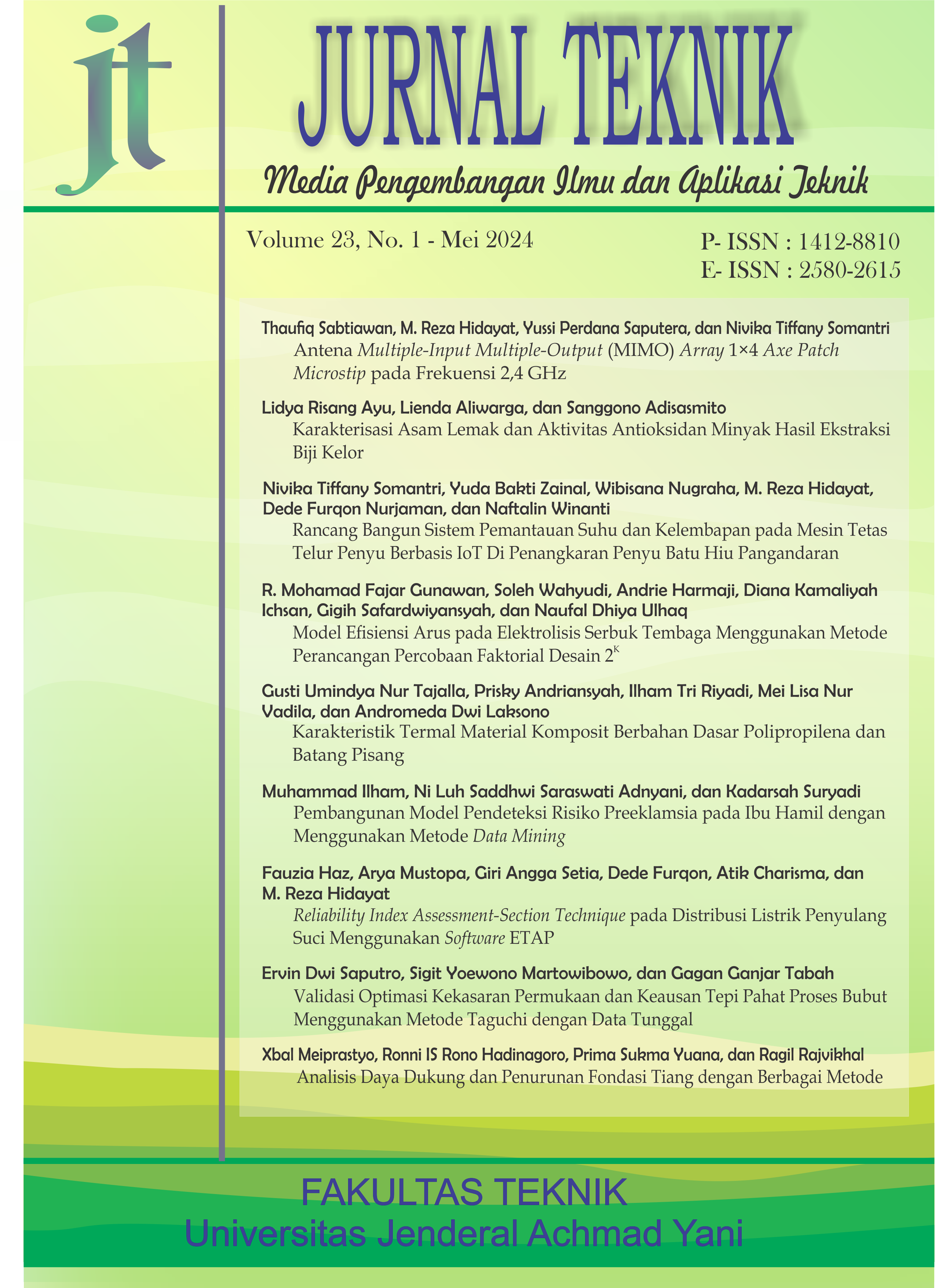
Model Efisiensi Arus pada Elektrolisis Serbuk Tembaga Menggunakan Metode Perancangan Percobaan Faktorial Desain 2K
DOI:
https://doi.org/10.55893/jt.vol23no1.552Keywords:
2K Design Factorial, Minitab, Electrolysis, Current Efficiency, Copper PowderAbstract
This paper presents the results of developing a current efficiency model for copper powder electrolysis and analyzes the factors that most influence current efficiency using a 2K factorial experimental design. The three independent variables are copper ion (Cu) concentration, current density, and electrolysis time. Copper powder electrolysis experiments were conducted using a pure copper plate anode (99.88% Cu) and a 316L stainless steel cathode. Current efficiency is calculated based on data on the weight of the copper powder produced. Copper powder characterization uses a Scanning Electron Microscope (SEM) to determine the morphology and size distribution of the powder, X-ray Diffraction (XRD) to identify powder phases/compounds, Energy Dispersive X-ray Spectroscopy (EDX) to analyze the elemental composition and Particle Size Analyzer ( PSA) to determine the powder particle size and distribution. The prediction model obtains the highest current efficiency at 96%. The resulting copper powder has a dendritic structure morphology with an average particle size of 114.9 µm. It comprises cuprite (Cu2O) and copper (Cu) with a composition of 88.17% Cu and 11.83% O.
References
Allen, T. T. (2019). Software Overview and Methods Review: Minitab. Introduction to Engineering Statistics and Lean Six Sigma, 575–600. https://doi.org/10.1007/978-1-4471-7420-2_24
Damisih, D., Fidyaningsih, R., Deca Pravitasari, R., Agustanhakri, A., Aprilia, L., & Purwati, H. (2015). Pembuatan Serbuk Tembaga Berukuran Di Bawah 1 Mikron dengan Metode Elektrolisis. PROSIDING SEMINAR NASIONAL FISIKA (E-JOURNAL), 4, SNF2015-VII-127–132. https://doi.org/10.21009/03
Grass, G., Rensing, C., & Solioz, M. (2011). Metallic copper as an antimicrobial surface. Applied and environmental microbiology, 77(5), 1541–1547. https://doi.org/10.1128/AEM.02766-10
Henny Mulyani, R., Carisca Tanjung, Y., Djoko, D., & Prajitno, H. (2019). The Effect of Variations in Current and Time to Manufacture Powder Tin (Sn) via Electrodeposition Process. Jurnal Kartika Kimia, 2(1), 7–16. https://doi.org/10.26874/JKK.V2I1.21
Hribernik, A., Bauman, M., & Lobnik, A. (2009). APLICATION OF 2 k FACTORIAL DESIGN IN WASTEWATER DECOLORIZATION RESEARCH. 19th IMEKO World Congress , 2225–2229.
Hurin, F. R. (2019). Pengaruh Penambahan Aditif Tiourea Terhadap Komposisi Oksigen pada Sintesis Serbuk Tembaga dengan Metode Elektrolisis [Institut Teknologi Sains Bandung]. https://repository.itsb.ac.id/index.php?p=show_detail&id=562
Montgomery, D. C. (2020). Design and Analysis of Experiments, 10th Edition, Wiley. Wiley, 1–682. https://www.wiley.com/en-us/Design+and+Analysis+of+Experiments%2C+10th+Edition-p-9781119492443
Mubarok, Z., & Wahyudi, S. (2017). Sintesis Serbuk Tembaga dengan Metode Elektrolisis: Studi Perilaku Elektrokimia dan Karakaterisasi Serbuk. Seminar Nasional Metalurgi dan Material (SENAMM) X 2017, 623–632. https://www.researchgate.net/publication/336721014
Nekouei, R. K., Rashchi, F., & Amadeh, A. A. (2013). Using design of experiments in synthesis of ultra-fine copper particles by electrolysis. Powder Technology, 237, 165–171. https://doi.org/10.1016/J.POWTEC.2013.01.032
Schlesinger, M. E., King, M. J., Sole, K. C., & Davenport, W. G. (2011). Extractive Metallurgy of Copper. Extractive Metallurgy of Copper, 1–455. https://doi.org/10.1016/C2010-0-64841-3
Sopiah, S. (2008). Analisis Faktor-Faktor yang Mempengaruhi Proses Elektrolisis Larutan CuSO4 Sebagai Bahan Kajian dalam Pembuatan Modul Praktikum dan Pembelajaran Elektronik [Institut Teknologi Bandung]. https://digilib.itb.ac.id/index.php/gdl/view/9280
Additional Files
Published
Issue
Section
License
Copyright (c) 2024 R. Mohamad Fajar Gunawan, Soleh Wahyudi, Andrie Harmaji, Diana Kamaliyah Ichsan, Gigih Safardwiyansyah, Naufal Dhiya Ulhaq

This work is licensed under a Creative Commons Attribution 4.0 International License.
Authors retain copyright and grant Jurnal Teknik: Media Pengembangan Ilmu dan Aplikasi Teknik the right of first publication. Articles are published open access under the Creative Commons Attribution 4.0 International License (CC BY 4.0), which permits use, sharing, adaptation, distribution, and reproduction in any medium or format, for any purpose, provided that appropriate credit is given to the original authors and source, a link to the license is provided, and any changes are indicated.