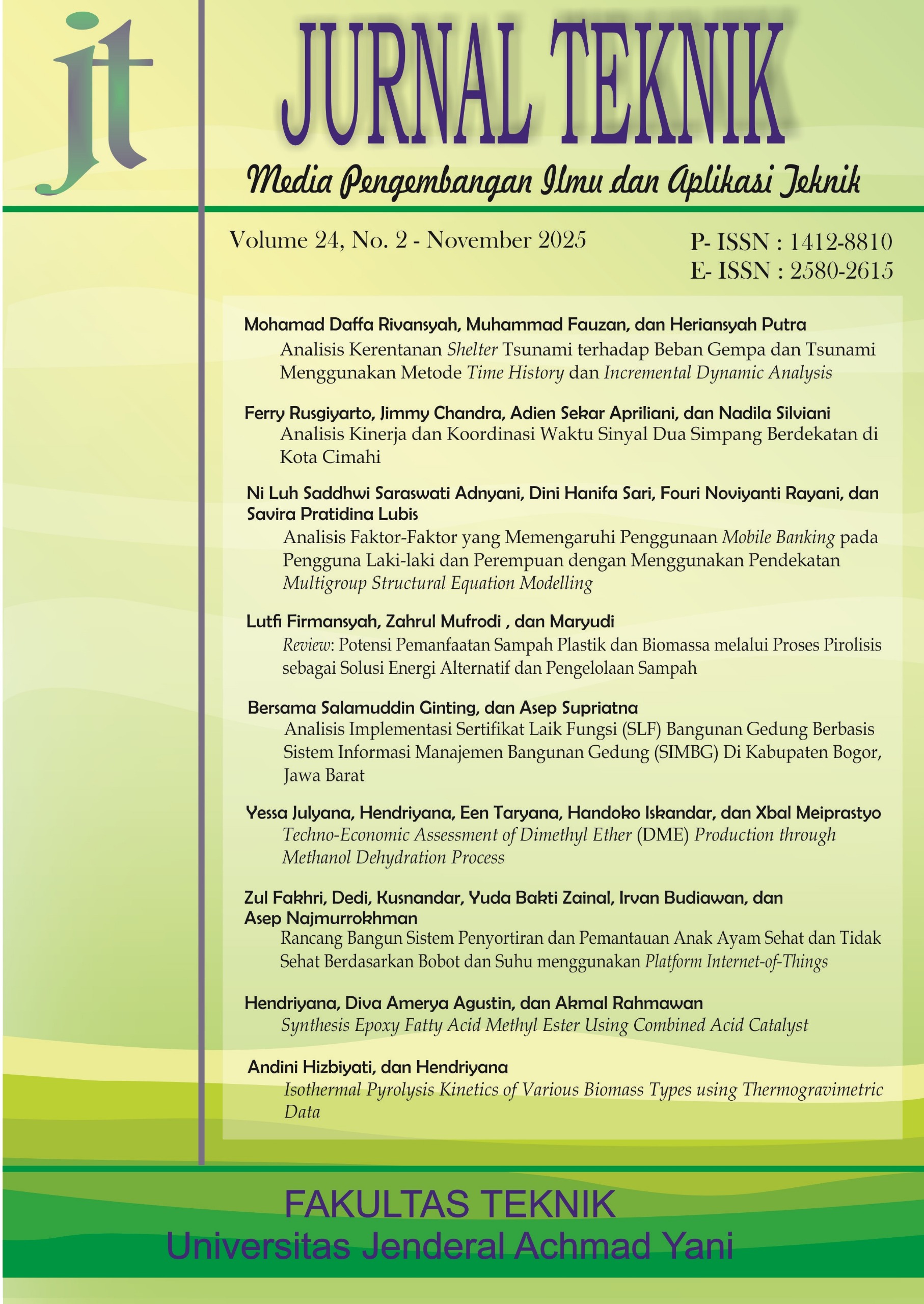
Review: Potensi Pemanfaatan Sampah Plastik dan Biomassa melalui Proses Pirolisis sebagai Solusi Energi Alternatif dan Pengelolaan Sampah
DOI:
https://doi.org/10.55893/jt.vol24no2.723Kata Kunci:
Sampah, Pirolisis, Biomassa, PlastikAbstrak
Ketergantungan terhadap penggunaan bahan bakar fosil memberikan dampak permasalahan diberbagai aspek seperti peningkatan emisi gas rumah kaca dan berkurangnya sumber energi tak terbarukan. Disisi lain isu timbulnya limbah/sampah khususnya limbah plastik dan biomassa menjadi tantangan global. Artikel ini membahas potensi konversi campuran limbah plastik dan biomassa menjadi bahan bakar alternatif menggunakan proses pirolisis. Proses pirolisis menjadi solusi ganda yaitu mengurangi akumulasi produksi limbah sekaligus menghasilkan energi alternatif yang bernilai ekonomis yakni bio-oil, bio-char dan syngas. Dalam implementasi proses pirolisis terdapat beberapa faktor seperti suhu operasi, jenis katalis, teknologi reaktor memiliki pengaruh terhadap hasil pirolisis. Diharapkan dengan pemahaman mendalam terhadap parameter dapat memberikan khasanah pengetahun dan pengembangan proses pirolisis. Sehingga dengan pemilihan teknologi yang tepat, pirolisis dapat menjadi solusi dalam mengatasi krisis energi dan isu lingkungan global.
Referensi
Abadi, M. S. A., Van Geem, K. M., Fathi, M., Bazgir, H., and Ghadiri, M. (2021). The pyrolysis of oak with polyethylene, polypropylene and polystyrene using fixed bed and stirred reactors and TGA instrument. Energy, 232, 121085. https://doi.org/10.1016/j.energy.2021.121085
Adams, P., Bridgwater, T., Lea-Langton, A., Ross, A., and Watson, I. (2017). Biomass conversion technologies. In Greenhouse gas balances of bioenergy systems. Elsevier Inc. https://doi.org/10.1016/B978-0-08-101036-5.00008-2
Adoga, S., Igbum, O. G., Okopi, G., Ikyenge, B. A., Ochi, O. I., and Ode, P. (2022). Catalytic pyrolysis of low density polyethylene and polypropylene wastes to fuel oils by N-clay. Ovidius University Annals of Chemistry, 33(1), 50-55. https://doi.org/10.2478/auoc-2022-0007
Aylon, E., Fernandez-Colino, A., Navarro, M. V., Murillo, R., Garcia, T., and Mastral, A. M. (2008). Waste tire pyrolysis: Comparison between fixed bed reactor and moving bed reactor. Industrial and Engineering Chemistry Research, 47(12), 4029-4033. https://doi.org/10.1021/ie071573o
Berrueco, E., Mastral, F. J., Ceamanos, J., and Garcia-Bacaicoa, P. (2005). Pyrolysis of waste tyres in an atmospheric static-bed batch reactor: Analysis of the gases obtained. Journal of Analytical and Applied Pyrolysis, 74(1-2), 245-253. https://doi.org/10.1016/j.jaap.2004.10.007
Burra, K. G., and Gupta, A. K. (2018). Kinetics of synergistic effects in co-pyrolysis of biomass with plastic wastes. Applied Energy, 220, 408-418. https://doi.org/10.1016/j.apenergy.2018.03.117
Chen, W., Shi, S., Zhang, J., Chen, M., and Zhou, X. (2016). Co-pyrolysis of waste newspaper with high-density polyethylene: Synergistic effect and oil characterization. Energy Conversion and Management, 112, 41-48. https://doi.org/10.1016/j.enconman.2016.01.005
Chen, D. E. W., and Koenig, L. R. (1988). Fluidized-bed upgrading of wood pyrolysis liquids and related compounds. ACS Symposium Series, 376, 277-289. https://doi.org/10.1021/bk-1988-0376.ch024
Engels, H. W., Pirkl, H. G., Albers, R., Albach, R. W., Krause, J., Hoffmann, A., Casselmann, H., and Dormish, J. (2013). Polyurethanes: Versatile materials and sustainable problem solvers for todays challenges. Angewandte Chemie International Edition, 52(36), 9422-9441. https://doi.org/10.1002/anie.201302766
Fu, P., Bai, X., Li, Z., Yi, W., Li, Y., and Zhang, Y. (2018). Fast pyrolysis of corn stovers with ceramic ball heat carriers in a novel dual concentric rotary cylinder reactor. Bioresource Technology, 263, 467-474. https://doi.org/10.1016/j.biortech.2018.05.033
Hassan, H., Lim, J. K., and Hameed, B. H. (2019). Catalytic co-pyrolysis of sugarcane bagasse and waste high-density polyethylene over faujasite-type zeolite. Bioresource Technology, 284, 406-414. https://doi.org/10.1016/j.biortech.2019.03.137
Hazman, N., Mat Isa, N., Nasir, N. F., Hussein, M., and A. D. S. (2024). The proximate and ultimate composition of pulverised coconut shell. International Journal of Integrated Engineering, 16(2), 270-277. https://doi.org/10.30880/ijie.2024.16.02.028
Maddah, H. A. (2016). Polypropylene as a promising plastic: A review. American Journal of Polymer Science, 6(1), 1-11. https://doi.org/10.5923/j.ajps.20160601.01
Institute for Essential Service Reform. (2023). Transisi berkeadilan di daerah penghasil batu bara di Indonesia. https://iesr.or.id/agenda-iesr/peluncuran-studi-transisi-berkeadilan-di-daerah-penghasil-batu-bara-di-indonesia-studi-kasus-kab-muara-enim-dan-kab-paser/
Kaniapan, S., Suhaimi, H., Hamdan, Y., and Pasupuleti, J. (2021). Experiment analysis on the characteristic of empty fruit bunch, palm kernel shell, coconut shell, and rice husk for biomass boiler fuel. Journal of Mechanical Engineering and Sciences, 15(3), 8300-8309. https://doi.org/10.15282/jmes.15.3.2021.08.0652
Kasar, P., and Ahmaruzzaman, M. (2021). Correlative HHV prediction from proximate and ultimate analysis of char obtained from co-cracking of residual fuel oil with plastics. Korean Journal of Chemical Engineering, 38(7), 1370-1380. https://doi.org/10.1007/s11814-021-0790-8
Kausar, A. (2018). A review of filled and pristine polycarbonate blends and their applications. Journal of Plastic Film and Sheeting, 34(1), 60-97. https://doi.org/10.1177/8756087917691088
Kementerian Lingkungan Hidup dan Kehutanan Republik Indonesia. (2023). Komposisi sampah nasional 2023. https://sipsn.menlhk.go.id/sipsn/public/data/komposisi
King, S. B. (2015). Lessons from China. JACC Cardiovascular Interventions, 8(14), 1911-1912. https://doi.org/10.1016/j.jcin.2015.09.007
Lameh, M., Abbas, A., Azizi, F., and Zeaiter, J. (2021). A simulation-based analysis for the performance of thermal solar energy for pyrolysis applications. International Journal of Energy Research, 45(10), 15022-15035. https://doi.org/10.1002/er.6781
Lynwood, C. (2019). Polystyrene: synthesis, characteristics and applications. Sustainability (Switzerland), 11(1). Nova Science Publishers, Inc.
Masek, O., Brownsort, P., Cross, A., and Sohi, S. (2013). Influence of production conditions on the yield and environmental stability of biochar. Fuel, 103, 151-155. https://doi.org/10.1016/j.fuel.2011.08.044
Mathew, M., and Muruganandam, L. (2017). Pyrolysis of agricultural biomass using an auger reactor: A parametric optimization. International Journal of Chemical Reactor Engineering, 15(3). https://doi.org/10.1515/ijcre-2016-0133
Mnyango, J. I., and Hlangothi, S. P. (2024). Polyvinyl chloride applications along with methods for managing its end-of-life items: A review. Progress in Rubber, Plastics and Recycling Technology, 40, 1-59. https://doi.org/10.1177/14777606241308652
Moriarty, P., and Honnery, D. (2012). What is the global potential for renewable energy? Renewable and Sustainable Energy Reviews, 16(1), 244-252. https://doi.org/10.1016/j.rser.2011.07.151
Motasemi, F., and Afzal, M. T. (2013). A review on the microwave-assisted pyrolysis technique. Renewable and Sustainable Energy Reviews, 28, 317-330. https://doi.org/10.1016/j.rser.2013.08.008
Muneer, B., Zeeshan, M., Qaisar, S., Razzaq, M., and Iftikhar, H. (2019). Influence of in-situ and ex-situ HZSM-5 catalyst on co-pyrolysis of corn stalk and polystyrene with a focus on liquid yield and quality. Journal of Cleaner Production, 237, 117762. https://doi.org/10.1016/j.jclepro.2019.117762
Nayak, P., and Datta, A. (2022). An entropy-based TOPSIS approach for selecting best suitable biomass. Biomass Conversion and Biorefinery. https://doi.org/10.1007/s13399-022-02824-3
Nistico, R. (2020). Polyethylene terephthalate (PET) in the packaging industry. Polymer Testing, 90, 106707. https://doi.org/10.1016/j.polymertesting.2020.106707
Olam, M., and Karaca, H. (2022). Characterization of products obtained of waste polyethylene terephthalate by pyrolysis. Environmental Progress and Sustainable Energy, 41(4). https://doi.org/10.1002/ep.13835
Olivera, S., Muralidhara, H. B., Venkatesh, K., Gopalakrishna, K., and Vivek, C. S. (2016). Plating on acrylonitrile-butadiene-styrene (ABS) plastic: A review. Journal of Materials Science, 51(8), 3657-3674. https://doi.org/10.1007/s10853-015-9668-7
Othman, B. N., and Yunus, M. (2008). Determination of physical and chemical characteristics of electronic plastic waste resin using proximate and ultimate analysis method. ICCBT, 16, 169-180.
Pattanayak, S., Hauchhum, L., Loha, C., and Sailo, L. (2020). Selection criteria of appropriate bamboo based biomass for thermochemical conversion process. Biomass Conversion and Biorefinery, 10(2), 401-407. https://doi.org/10.1007/s13399-019-00421-5
Pinto, F., Miranda, M., and Costa, P. (2016). Production of liquid hydrocarbons from rice crop wastes mixtures by co-pyrolysis and co-hydropyrolysis. Fuel, 174, 153-163. https://doi.org/10.1016/j.fuel.2016.01.075
Prabhakara, M., Bramer, E. A., and Brem, G. (2021). Role of dolomite as an in-situ CO2 sorbent and deoxygenation catalyst in fast pyrolysis of beechwood in a bench scale fluidized bed reactor. Fuel Processing Technology, 224, 107029. https://doi.org/10.1016/j.fuproc.2021.107029
Quan, C., Gao, N., and Song, Q. (2016). Pyrolysis of biomass components in a TGA and a fixed-bed reactor: Thermochemical behaviors, kinetics, and product characterization. Journal of Analytical and Applied Pyrolysis, 121, 84-92. https://doi.org/10.1016/j.jaap.2016.07.005
Qureshi, K. M., Kay Lup, A. N., Khan, S., Abnisa, F., and Wan Daud, W. M. A. (2018). A technical review on semi-continuous and continuous pyrolysis process of biomass to bio-oil. Journal of Analytical and Applied Pyrolysis, 131, 52-75. https://doi.org/10.1016/j.jaap.2018.02.010
Salakhov, I. I., Shaidullin, N. M., Chalykh, A. E., Matsko, M. A., Shapagin, A. V., Batyrshin, A. Z., Shandryuk, G. A., and Nifantev, I. E. (2021). Low-temperature mechanical properties of high-density and low-density polyethylene and their blends. Polymers, 13(11), 1821. https://doi.org/10.3390/polym13111821
Selvaganapathy, M., Muthuvelayudham, R., and Jayakumar, M. (2019). Process parameter optimization study on thermolytic polystyrene liquid fuel using response surface methodology. Materials Today Proceedings, 26, 2729-2739. https://doi.org/10.1016/j.matpr.2020.02.572
Stancin, H., Mikulcic, H., Manic, N., Stojiljkovic, D., Vujanovic, M., Wang, X., and Duic, N. (2021). Thermogravimetric and kinetic analysis of biomass and polyurethane foam mixtures co-pyrolysis. Energy, 237, 121592. https://doi.org/10.1016/j.energy.2021.121592
Suhaj, P., Husar, J., and Haydary, J. (2020). Gasification of RDF and its components with tire pyrolysis char as tar-cracking catalyst. Sustainability (Switzerland), 12(16), 6647. https://doi.org/10.3390/su12166647
Suhartono, Harsanti, M., Septiyanti, W., Suharto, and Achmad, F. (2022). Zeolite catalytic pyrolysis of waste tire into fuel in gasoline hydrocarbon range. IOP Conference Series Earth and Environmental Science, 969(1), 012030. https://doi.org/10.1088/1755-1315/969/1/012030
Suhartono, Romli, A., Prabowo, B. H., Kusumo, P., and Suharto. (2023). Converting styrofoam waste into fuel using a sequential pyrolysis reactor and natural zeolite catalytic reformer. International Journal of Technology, 14(1), 185-194. https://doi.org/10.14716/ijtech.v14i1.4907
Uzoejinwa, B. B., He, X., Wang, S., Abomohra, A. E. F., Hu, Y., and Wang, Q. (2018). Co-pyrolysis of biomass and waste plastics as a thermochemical conversion technology for high-grade biofuel production: Recent progress and future directions elsewhere worldwide. Energy Conversion and Management, 163, 468-492. https://doi.org/10.1016/j.enconman.2018.02.004
Varma, A. K., Thakur, L. S., Shankar, R., and Mondal, P. (2019). Pyrolysis of wood sawdust: Effects of process parameters on products yield and characterization of products. Waste Management, 89, 224-235. https://doi.org/10.1016/j.wasman.2019.04.016
Williams, A., Jones, J. M., Ma, L., and Pourkashanian, M. (2012). Pollutants from the combustion of solid biomass fuels. Progress in Energy and Combustion Science, 38(2), 113-137. https://doi.org/10.1016/j.pecs.2011.10.001
Wilson, D., Rodic, L., Modak, P., Soss, R., Rogero, A., Velis, C., Iyer, M., and Simonett, O. (2022). Global waste management outlook.
Wright, V. P. (2024). World energy outlook. International Energy Agency.
Yang, L., Cui, C., Liu, S., Qiu, Q., Ding, Y., Wu, Y., and Zhang, B. (2016). Catalytic hydroprocessing of microalgae-derived biofuels: A review. Green Chemistry, 18(13), 3684-3699. https://doi.org/10.1039/c6gc01239f
Zhang, B., Zhong, Z., Min, M., Ding, K., Xie, Q., and Ruan, R. (2015). Catalytic fast co-pyrolysis of biomass and food waste to produce aromatics: Analytical Py-GC/MS study. Bioresource Technology, 189, 30-35. https://doi.org/10.1016/j.biortech.2015.03.092
Zhang, Y. T. C., Vispute, T. P., Xiao, R., and Huber, G. W. (2011). Catalytic conversion of biomass-derived feedstocks into olefins and aromatics with ZSM-5: The hydrogen to carbon effective ratio. Energy and Environmental Science, 4(6), 2297-2307. https://doi.org/10.1039/c1ee01230d
Zhang, Y., Zhao, Y., Wang, D., Yan, M., Zhang, J., Zhang, P., Ding, T., Chen, L., and Chen, C. (2021). Current technologies for plastic waste treatment: A review. Journal of Cleaner Production, 282, 124523. https://doi.org/10.1016/j.jclepro.2020.124523
File Tambahan
Diterbitkan
Terbitan
Bagian
Lisensi
Hak Cipta (c) 2025 Lutfi Firmansyah, Zahrul Mufrodi , Maryudi

Artikel ini berlisensiCreative Commons Attribution-NonCommercial-ShareAlike 4.0 International License.
Penulis yang menyerahkan artikel di Jurnal Teknik: Media Pengembangan dan Aplikasi Teknik untuk keperluan publikasi telah mengetahui bahwa Jurnal Teknik: Media Pengembangan dan Aplikasi Teknik memberikan akses terbuka terhadap konten untuk mendukung pertukaran informasi mengenai ilmu pengetahuan, sesuai dengan penerbitan daring yang berbasis Open Access Journal dan mengikuti Creative Commons Attribution 4.0 International License. Sehingga penulis setuju dengan ketentuan-ketentuan berikut:
1. Penulis memegang hak cipta dan memberikan hak publikasi pertama kepada pihak jurnal dengan pekerjaan secara bersamaan
di bawah Creative Commons Attribution 4.0 International License yang memungkinkan orang lain untuk berbagi pekerjaan
dengan pengakuan kepengarangan karya dan publikasi pertama artikel tersebut di Jurnal Teknik: Media Pengembangan dan
Aplikasi Teknik.
2. Penulis dapat melakukan perjanjian tambahan untuk hak distribusi non-eksklusif artikel yang telah diterbitkan di jurnal ini
(misalnya, posting ke sebuah repositori institusi atau menerbitkannya dalam sebuah buku), dengan mengakui bahwa
publikasi pertama dilakukan di Jurnal Teknik: Media Pengembangan dan Aplikasi Teknik.
3. Penulis diizinkan dan didorong untuk menyebarkan karya mereka secara daring (misalnya, dalam repositori institusi atau
laman web penulis) setelah artikel terbit (proses penerbitan artikel selesai). Hal ini terkait dengan imbas dari pertukaran
informasi yang produktif (Lihat Pengaruh Open Access).