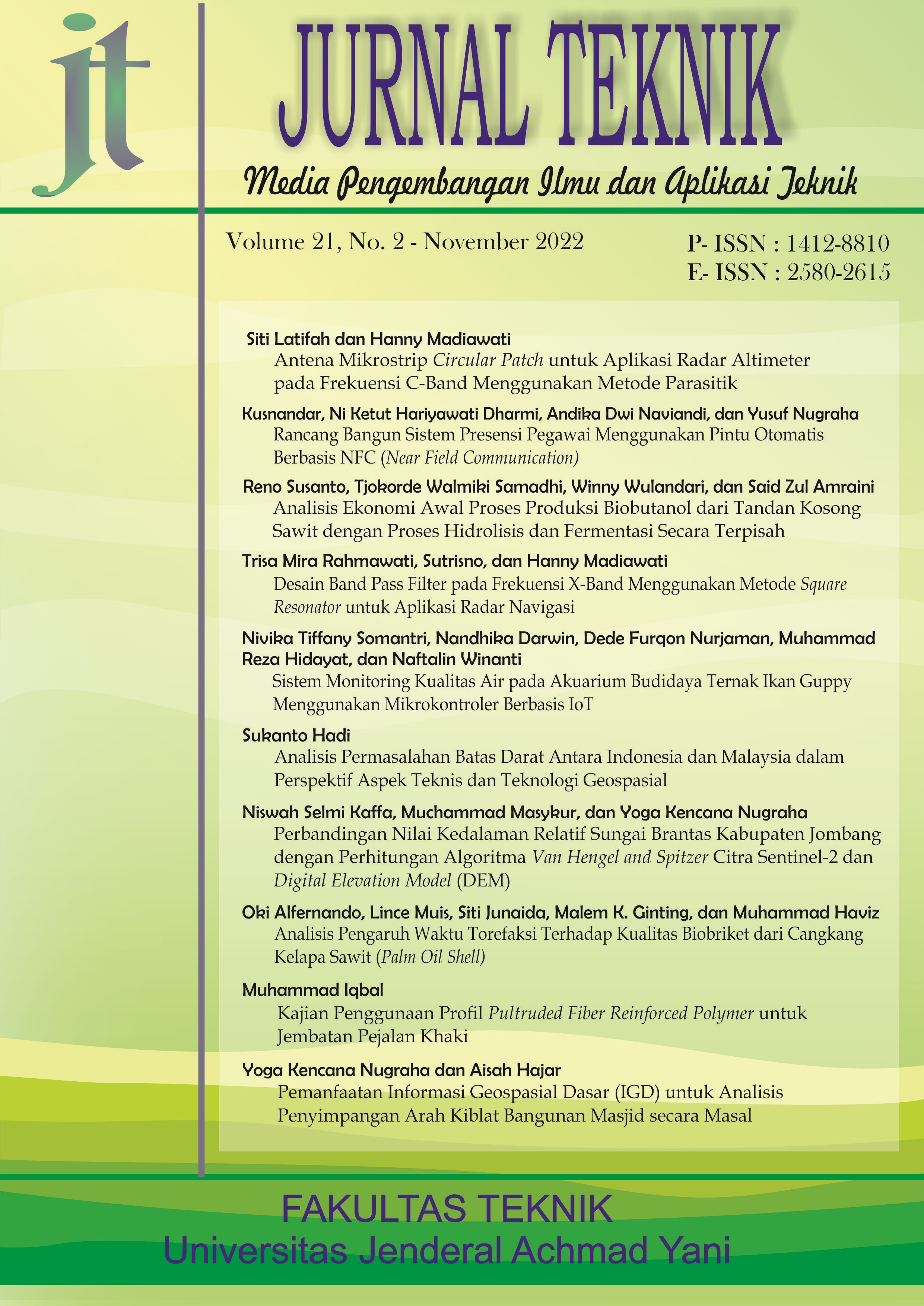
Analisis Ekonomi Awal Proses Produksi Biobutanol dari Tandan Kosong Sawit dengan Proses Hidrolisis dan Fermentasi Secara Terpisah
DOI:
https://doi.org/10.55893/jt.vol21no2.447Keywords:
biofuel, biobutanol, separated hydrolysis fermentationAbstract
The limitation of petroleum reserves and environmental issues have led countries worldwide to shift towards producing and utilizing biofuels as an alternative solution to replace fossil fuels. One of the biofuels that can be used is biobutanol, which can be produced from residual waste containing lignocellulose. An empty fruit bunch (EFB) from oil palm is a residual waste used as raw material for biobutanol production. The method that can be used in biobutanol production is the Separated Hydrolysis and Fermentation (SHF) process, which allows the cellulose hydrolysis process to be pre-treated with acid at lower temperature but for longer time or at higher temperature for shorter time. The product from Clostridium acetobutylicum using hydrolysate from cellulose hydrolysis is higher than that from acid hydrolysis. The cellulase enzyme hydrolysis process can be separated from the fermentation process according to their optimum conditions. From the initial economic analysis calculation with production basis of 10,000 tons per year, total gross profit margin of IDR 39,459/kg was obtained, indicating that biobutanol production from EFB biomass is economically feasible and profitable. Further study is needed to conduct a techno-economic analysis of the biobutanol production process using EFB as raw material.
Additional Files
Published
Issue
Section
License
Copyright (c) 2023 Reno Susanto, Tjokorde Walmiki Samadhi, Winny Wulandari, Said Zul Amraini

This work is licensed under a Creative Commons Attribution 4.0 International License.
Authors retain copyright and grant Jurnal Teknik: Media Pengembangan Ilmu dan Aplikasi Teknik the right of first publication. Articles are published open access under the Creative Commons Attribution 4.0 International License (CC BY 4.0), which permits use, sharing, adaptation, distribution, and reproduction in any medium or format, for any purpose, provided that appropriate credit is given to the original authors and source, a link to the license is provided, and any changes are indicated.