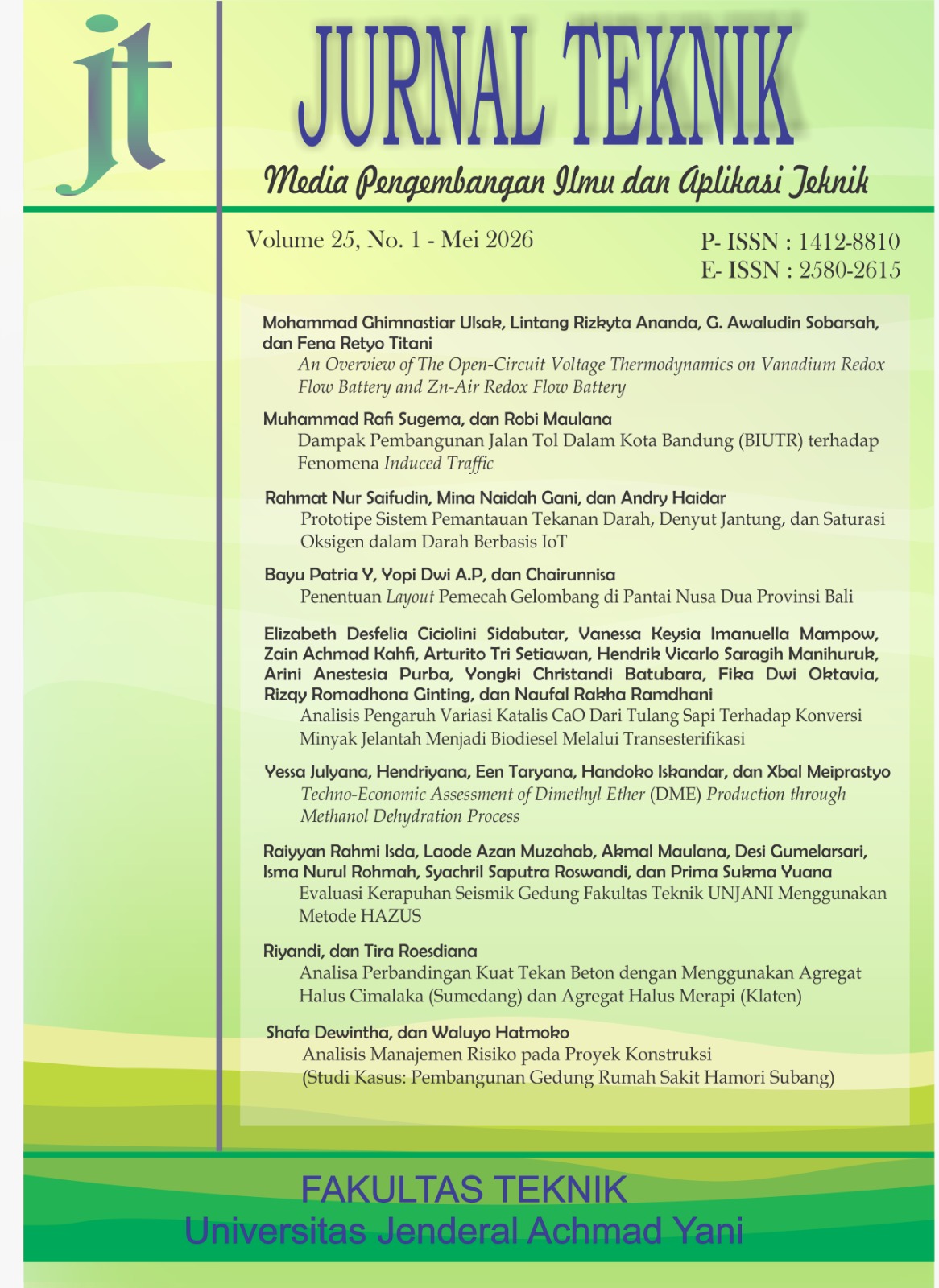
Analisis Pengaruh Variasi Katalis CaO Dari Tulang Sapi Terhadap Konversi Minyak Jelantah Menjadi Biodiesel Melalui Transesterifikasi
DOI:
https://doi.org/10.55893/jt.vol25no1.823Keywords:
biodiesel, waste cooking oil, CaO catalyst, calcination, transesterificationAbstract
Biodiesel production from waste cooking oil is challenged by its high free fatty acid (FFA) content, which can promote saponification and reduce catalyst performance. Heterogeneous CaO catalyst derived from bovine bone waste offers a promising alternative due to its higher tolerance toward FFA. This study investigated the effects of methanol-to-oil molar ratios (5:1 and 12:1), catalyst calcination temperatures (800oC and 1000oC), calcination times (3, 5, and 7 h), and catalyst concentrations (4 and 6 wt%) on biodiesel yield from waste cooking oil. CaO catalyst was synthesized from bovine bones through calcination and applied in a 1 h transesterification reaction. Biodiesel yield was used to evaluate the influence of calcination and reaction conditions. The results showed that the 12:1 molar ratio provided higher conversion than the 5:1 ratio. The optimum condition was obtained at a calcination temperature of 1000 oC for 5 h with a catalyst concentration of 4–6 wt%, yielding a maximum biodiesel yield of 73%. The increase in yield from 46% to 73% indicates enhanced formation of active CaO and O2- basic sites, which facilitate methoxide ion generation during transesterification. These findings demonstrate the potential of bovine bone-derived CaO catalyst for biodiesel production without esterification.
References
Al-Yasiri, A. (2021). Global energy demand for different energy sources: Current status and future prospects. Akkad Journal of Contemporary Economic Studies, 1(4), 186-196.
Ayoola, A. A., Fayomi, O. S. I., & Usoro, I. F. (2018). Data on PKO biodiesel production using CaO catalyst from turkey bones. Data in Brief, 19, 789–797. https://doi.org/10.1016/j.dib.2018.05.103
Aziz, H. A., Abas, N. A., Ping, B. T. Y., & Idris, Z. (2020). Transesterification of Palm‐based Methyl Palmitate into Esteramine Catalyzed by Calcium Oxide Catalyst. Journal of Surfactants and Detergents, 23(2), 251–262. https://doi.org/10.1002/jsde.12373
Azizah, Z., Wardhana, W., & Fitri, M. A. (2024). PEMANFAATAN IKAN PATIN MENJADI BAHAN BAKU BIODIESEL. Jurnal Chemurgy, 8(1), 68. https://doi.org/10.30872/cmg.v8i1.11495
Azni, M. A., Ahmad, N., Mohammed, W. M. W., & Rahman, R. A. (2023). Review of the effects of fossil fuels and the need for hydrogen fuel cell policy in Malaysia. Sustainability, 15, 4033. https://doi.org/10.3390/su15054033
Bai, H., Liu, X., Bao, F., & Zhao, Z. (2019). Synthesis of micronized CaO assisted by NH HCO with Ca(OH) and its application in heterogeneously catalyzing transesterification reaction for producing biodiesel. Journal of the Chinese Chemical Society, 66(12), 1604–1609. https://doi.org/10.1002/jccs.201900023
Buchori, L., Anggoro, D. D., & Ma’Ruf, A. (2021). Biodiesel synthesis from the used cooking oil using CaO catalyst derived from waste animal bones. Chemistry and Chemical Technology, 15(4), 583-590. https://doi.org/10.23939/CHCHT15.04.583
Corro, G., Sánchez, N., Pal, U., & Bañuelos, F. (2016). Biodiesel production from waste frying oil using waste animal bone and solar heat. Waste Management, 47, 105–113. https://doi.org/10.1016/j.wasman.2015.02.001
El-Araby, R., dkk. (2024). Biofuel production: Exploring renewable energy solutions for a greener future. Biotechnology for Biofuels and Bioproducts, 17, 129, 1-32.
Eze, V. C., & Harvey, A. P. (2018). Continuous reactive coupling of glycerol and acetone – A strategy for triglyceride transesterification and in-situ valorisation of glycerol by-product. Chemical Engineering Journal, 347, 41–51. https://doi.org/10.1016/j.cej.2018.04.078
Hanifah, P. R., & Purbadharmaja, I. B. P. (2025). Analisis pengaruh konsumsi listrik dan konsumsi bahan bakar fosil terhadap eksternalitas negatif emisi gas rumah kaca di Indonesia. Jurnal Visi Manajemen, 11(2), 298-314.
Haryanto, A., Silviana, U., Triyono, S., & Prabawa, S. (2015). Produksi biodiesel dari transesterifikasi minyak jelantah dengan bantuan gelombang mikro: Pengaruh intensitas daya dan waktu reaksi terhadap rendemen dan karakteristik biodiesel. Agritech, 35(2), 234–240. https://doi.org/10.22146/agritech.13792
Hussain, F., Alshahrani, S., Abbas, M. M., Khan, H. M., Jamil, A., Yaqoob, H., Soudagar, M. E. M., Imran, M., Ahmad, M., & Munir, M. (2021). Review waste animal bones as catalysts for biodiesel production; a mini review. In Catalysts (Vol. 11, Issue 5). MDPI. https://doi.org/10.3390/catal11050630
Ministry of Energy and Mineral Resources. (2021). Statistik minyak goreng nasional 2021. ESDM Press.
Mohadesi, M., Gouran, A., & Dehghan Dehnavi, A. (2021). Biodiesel production using low cost material as high effective catalyst in a microreactor. Energy, 219. https://doi.org/10.1016/j.energy.2020.119671
Mohamad, M., Ngadi, N., & Lani, N. S. (2015). Production of Biodiesel from Cooking Oil Using CaO Catalyst. Advanced Materials Research, 1113, 518– 522. https://doi.org/10.4028/www.scientific.net/AMR.1113.518
Nadya, S., Mas’udah, & Santosa, S. (2023). Pengaruh rasio katalis CaO-NaOH dan waktu reaksi transesterifikasi terhadap kualitas biodiesel dari minyak sawit. Distilat, 9(3), 330-337.
Nugroho, A. P., Rahmatullah, B., Abduh, M., & Amelia, R. (2024). Optimization of biodiesel from waste cooking oil using modified catalysts and its emission characteristics. Journal of Mechanical Engineering Research, 5(2), 45-55.
Singh, D., Sharma, D., Soni, S. L., Inda, C. S., Sharma, S., & Jhalani, A. (2021). A comprehensive review on biodiesel production from waste cooking oil. Fuel, 307, 121-129.
Udayakumar, M., Aravind, V. S., Prakash, M., & Suresh, S. (2024). Biodiesel production, fuel properties, engine performance and emission characteristics: A comprehensive review. Renewable Energy Reviews, 92(1), 1-25.
Wan Osman, N. H., Rahman, N. A., & Hassan, M. H. (2024). Advances in biodiesel production and purification: Current technologies and future directions. Energy Conversion and Management, 305, 117-134.
Wang, Q., & Azam, M. (2024). Natural resource scarcity, fossil fuel energy consumption and environmental impact: Evidence from major economies. Geoscience Frontiers, 15(1), 1-15.
Wong, Y. C., Tan, Y. P., Taufiq-Yap, Y. H., Ramli, I., & Tee, H. S. (2015). Biodiesel production via transesterification of palm oil by using CaO–CeO2 mixed oxide catalysts. Fuel, 162, 288–293. https://doi.org/10.1016/j.fuel.2015.09.012
Additional Files
Published
Issue
Section
License
Copyright (c) 2026 Elizabeth Desfelia Ciciolini Sidabutar, Vanessa Keysia Imanuella Mampow, Zain Achmad Kahfi, Arturito Tri Setiawan, Hendrik Vicarlo Saragih Manihuruk, Arini Anestesia Purba, Yongki Christandi Batubara, Fika Dwi Oktavia, Rizqy Romadhona Ginting, Naufal Rakha Ramdhani

This work is licensed under a Creative Commons Attribution 4.0 International License.
Authors retain copyright and grant Jurnal Teknik: Media Pengembangan Ilmu dan Aplikasi Teknik the right of first publication. Articles are published open access under the Creative Commons Attribution 4.0 International License (CC BY 4.0), which permits use, sharing, adaptation, distribution, and reproduction in any medium or format, for any purpose, provided that appropriate credit is given to the original authors and source, a link to the license is provided, and any changes are indicated.