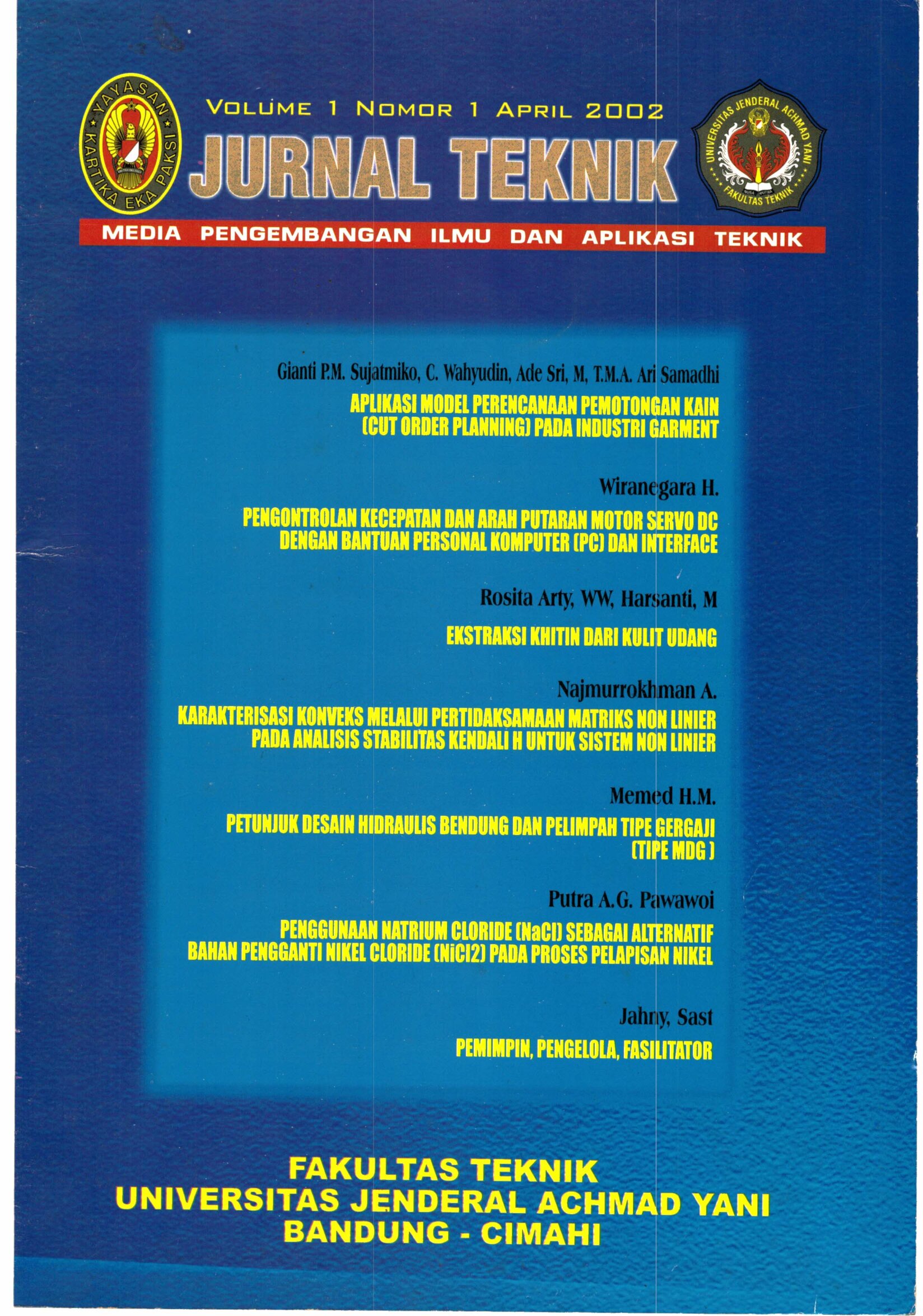
Karakterisasi Konveks Melalui Pertidaksamaan Matriks Non Linier pada Analisis Stabilitas Kendali H∞ untuk Sistem Non Linier
DOI:
https://doi.org/10.26874/jt.vol1no1.196Keywords:
Kendali H∞, Pertidaksamaan Matriks Non Linier, Stabilitas Asimtotik, Penguatan-L2 KarakterisasiAbstract
In this paper, stability analysis of nonlinear systems is considered. Existence of Lyapunov function as stability guarantee for a class of nonlinear systems is characterized in terms of nonlinear matrix inequalities which result in convex feasibility problems. A numerical example will be shown for clarity this method. The issue of solutions to these nonlinear matrix inequalities is proposed.
References
2. Boyd, S., et. al., 1994. “Linear Matrix Ineguality in System and Control Theoryâ€, SIAM Series, April, Philadelphia, USA.
3. Doyle, J. C., et. al., 1989. “State Space Solutions to Standard H» and H., Control Problemsâ€, IEEE Trans. AC, vol. AC-34, pp. 831 — 846.
4. El Ghaoui, L., et. al., 2000. “Advance in Linear Matrix Ineguality Methods in Controlâ€, SIAM Series, Philadelphia, USA.
5. Isidori, A., et. al., 1992. “Disturbance Attenuation and H., Control via Measurement Feedback in Nonlinear Systemsâ€, IEEE Trans. AC, vol. AC-38, pp. 546 — 559.
6. Lu, W.M. and Doyle, J.C., 1995. â€H., Control of Nonlinear Systems : A Convex Characterization†, IEEE Trans. AC, vol. AC-40, pp. 1668 — 1675.
7. van der Schaft, A.J. , 1992. â€L-Gain Analysis of Nonlinear Systems and Nonlinear State Feedback H., Control†, IEEE Trans. AC, vol. AC-37, pp. 770 — 784.
8. Yuliar, S., 1996. “Dissipative Systems Theory : Analysis and Synthesisâ€, PhD Dissertation, Australian National University, Australia
9. ____________, 1993, “Nonlinear State Space H.,-control Theoryâ€, Perspectives in Control. (eds. H.L. Trentelman and J.C. Willems), Birkhauser, Netherland.
Additional Files
Published
Issue
Section
License
Authors retain copyright and grant Jurnal Teknik: Media Pengembangan Ilmu dan Aplikasi Teknik the right of first publication. Articles are published open access under the Creative Commons Attribution 4.0 International License (CC BY 4.0), which permits use, sharing, adaptation, distribution, and reproduction in any medium or format, for any purpose, provided that appropriate credit is given to the original authors and source, a link to the license is provided, and any changes are indicated.