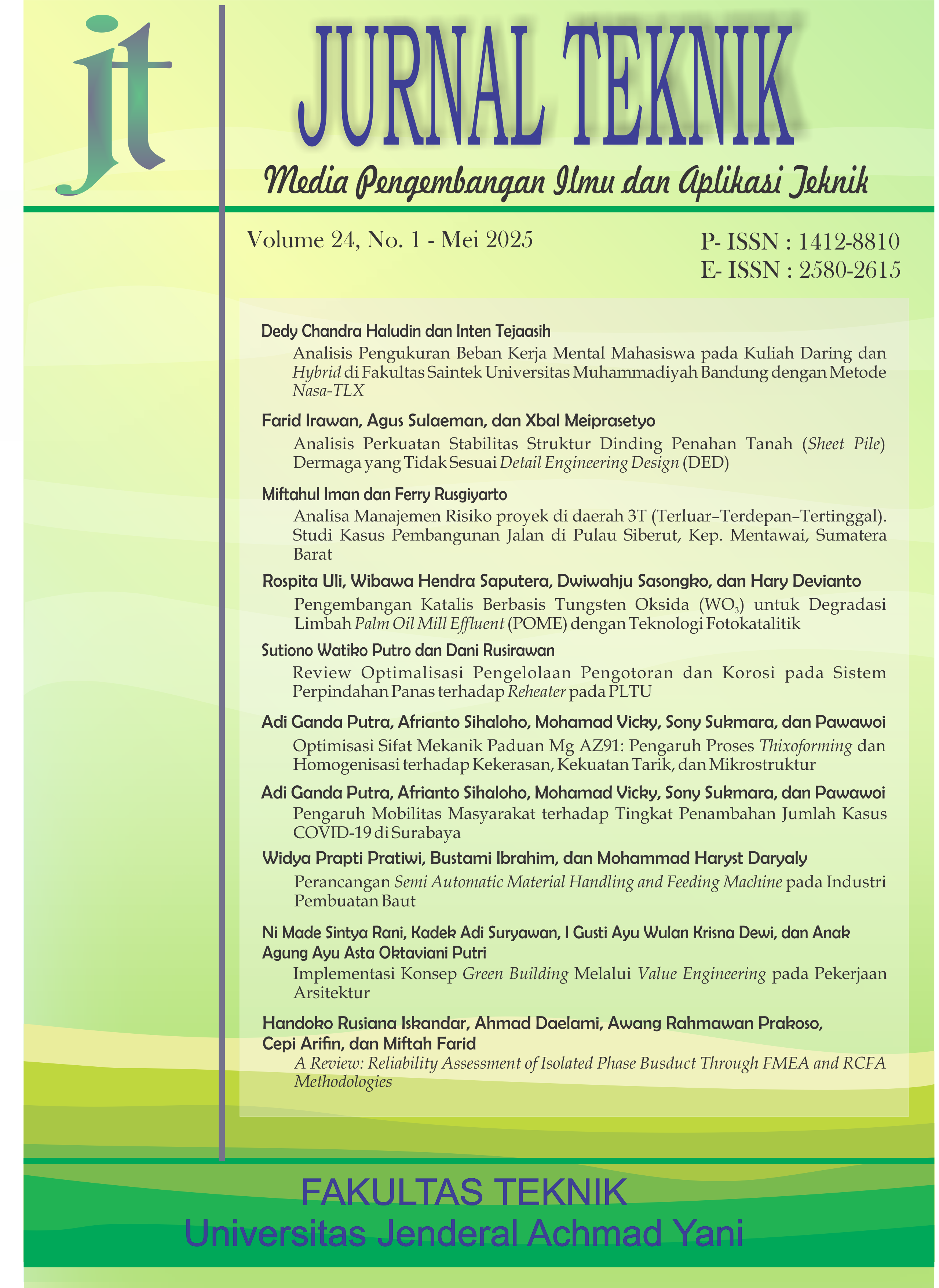
Analisis Perkuatan Stabilitas Struktur Dinding Penahan Tanah (Sheet Pile) Dermaga yang Tidak Sesuai Detail Engineering Design (DED)
DOI:
https://doi.org/10.55893/jt.vol24no1.527Keywords:
ship dock, reinforcement stability, Corrugated Concrete sheet pile (ccsp), Concrete Sheet Pile (CSP), tie rodAbstract
A wharf is a key infrastructure at a port that functions as a place for ships to dock and moor while conducting the loading and unloading of cargo, as well as passenger activities. The structural integrity of the wharf, especially along the bank, must be carefully designed to ensure ships can anchor securely. In pier construction, slope reinforcement is often done using sheet piles. When designing sheet piles, important factors such as pile depth and soil type must be considered. However, in practice, challenges arise when the construction in the field does not align with the specifications outlined in the Detail Engineering Design (DED), potentially compromising the wharf’s stability. This research aims to determine whether the reinforcement already implemented meets safety standards and technical requirements to prevent structural failure. A civil engineering approach is applied by reanalyzing the stability of existing reinforcements. The method involves evaluating the strength of the pier structure using various reinforcement types, including Corrugated Concrete Sheet Pile (CCSP), Concrete Sheet Pile (CSP), and Tie Rods. These evaluations are carried out through numerical calculations and structural analysis using the Plaxis program to simulate performance and ensure the design's reliability under both normal and seismic conditions.
References
Alfianty, Desi, 2019, “Studi Kestabilan Perkuatan Tebing Dermaga Quay Wall Di Matan Kabupaten Kayong Utara,” : 1–10,
Anbya, Yasinta Yati Nur, 2015, “Studi Perencanaan Desain Turap Baja Dengan Metode Finite Element Di Bantaran Sungai Jelarai Tanjung Selor,”
Craig, R,F,, and Budi Susilo, 1989, “Mekanika Tanah, Edisi IV,”: 6, 19, 109,110, 171,174,176,https://labmekanikatanah,files,wordpress,com/2013/07/mekanika-tanah-r-f-craig,pdf,
Das, Braja M, 1993, “Mekanika Tanah (Prinsip-Prinsip Rekayasa Geoteknis) Jilid 2,” Erlangga: 239,
Hardiyatmo, Hary Christady, 2010, “Mekanika Tanah I, Edisi III,” Angewandte Chemie International Edition, 6(11), 951–952,
Ihsan, Pemi, “Fenomena Cerucuk Sebagai Peningkatan Daya Dukung Dan Mereduksi Penurunan Beban Bangunan Di Atas Tanah Lembek,”
Nazir, Muhammad Shahid et al, 2018, “Analisis Kestabilan Lereng Studi Kasus Kelongsoran Ruas Jalan Sicincin-Malalak KM 27,6 Kecamatan Malalak, Kabupaten Agam,” Spectrochimica Acta - Part A,
Pasaribu, Bangun, Jupriah Sarifah, and Ahmad Fidel Rifky, 2021, “Analisa Faktor Keamanan Tiang Pada Pembangunan Dermaga SImiando Kabupaten Samosir,”
SNI-8460 (2017), “Persyaratan Perancangan Geoteknik,” SNI 8460-2017 8460:2017,
Swardana, Ryan, 2019, Universitas Internasional Batam Perencanaan Pembangunan Dinding Penahan Tanah Tipe Gravitasi Di Universitas Internasional Batam, Batam,
Wesley, Laurence D, 2012, “Mekanika Tanah Untuk Tanah Endapan Dan Residu,” : 577, http://web,ipb,ac,id/~erizal/mektan/2010_Mekanika Tanah untuk Tanah endapan dan residu,pdf,
Zulfikar, A, 2020, “Mengenal Fungsi Dan Jenis Dinding Penahan Tanah, Konstruksi Lahan Miring,”
Additional Files
Published
Issue
Section
License
Copyright (c) 2025 Farid Irawan, Agus Sulaeman, Xbal Meiprasetyo

This work is licensed under a Creative Commons Attribution 4.0 International License.
Authors retain copyright and grant Jurnal Teknik: Media Pengembangan Ilmu dan Aplikasi Teknik the right of first publication. Articles are published open access under the Creative Commons Attribution 4.0 International License (CC BY 4.0), which permits use, sharing, adaptation, distribution, and reproduction in any medium or format, for any purpose, provided that appropriate credit is given to the original authors and source, a link to the license is provided, and any changes are indicated.