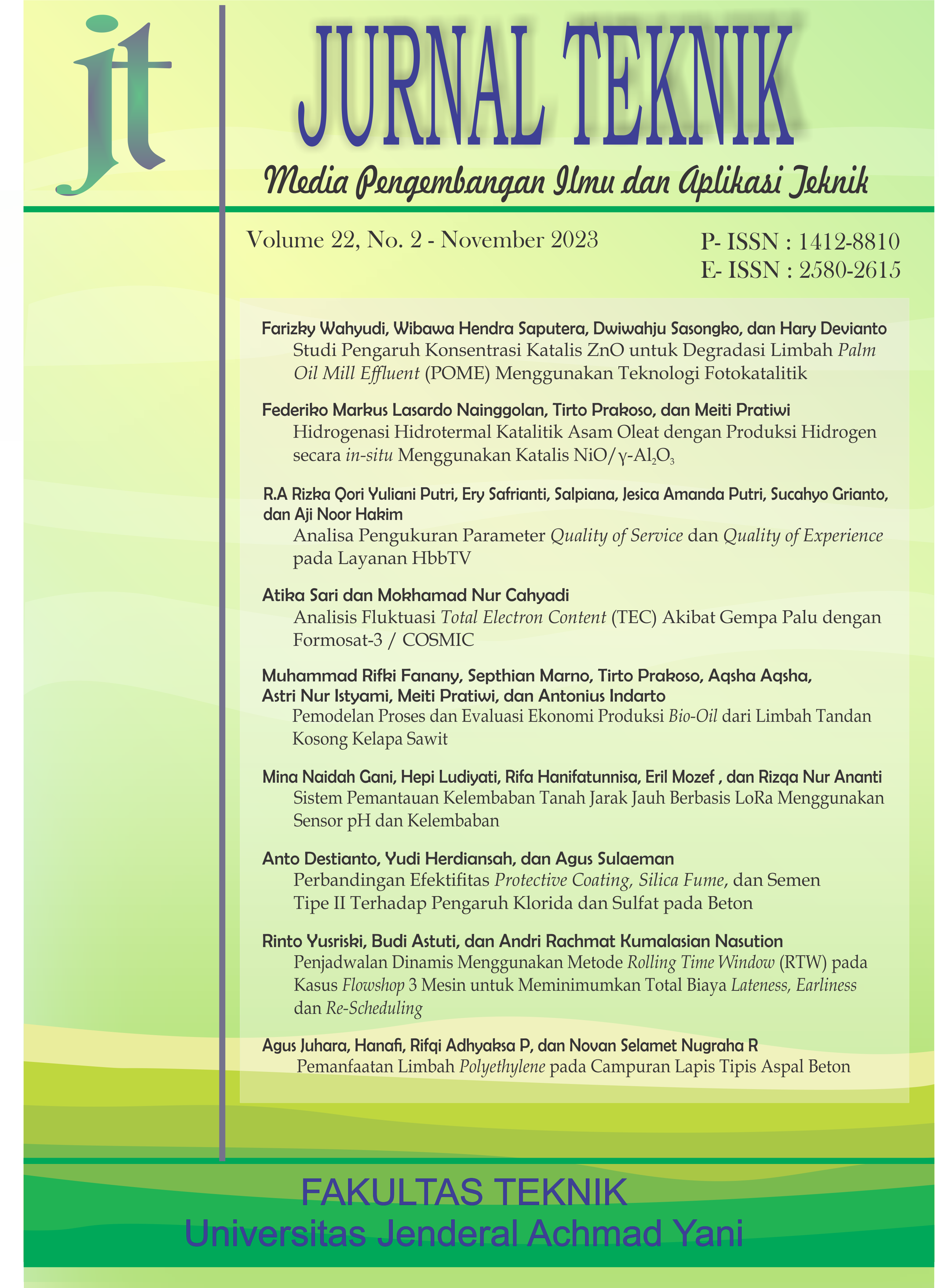
Perbandingan Efektifitas Protective Coating, Silica Fume dan Semen Tipe II Terhadap Pengaruh Klorida dan Sulfat pada Beton
DOI:
https://doi.org/10.55893/jt.vol22no2.508Keywords:
Chloride and Sulfate , ConcreteAbstract
Concrete that is in a surrounding with high sulfate and chloride levels can affect durability of concrete. Numerous technologies that might be often used include: protecting coating, addition of silica fume to concrete mix, and type II cement. Consequently, the intention of this have a look at was to examine effectiveness of shielding coatings, the addition of silica fume to the concrete blend, and the usage of kind II cement to grow the sturdiness of concrete uncovered to chlorides and sulfates. The specimens were made in 4 variations; cement type I specimens without protection, cement type I specimens with coating, cement type I specimens with silica fume, and cement type II without protection. The specimens were immersed in a solution of chloride and sulfate for 14 days, 28 days, 42 days, and 56 days. The study was carried out by testing the compressive strength, chloride content, chloride infiltration, visual analysis, and change of length. The results showed that protective coating had resistance to chloride and sulfate, the addition of silica fume to cement type I provided resistance to chloride but did not to sulfate, while the use of cement type II provided resistance to sulfate but did not provide chloride.
References
ACI 301-16. (2016). Specifications for Structural Concrete, Farmington Hills: American Concrete Institute
ACI 234-06. (2006). Guide for the Use of Silica Fume in Concrete, Farmington Hills: American Concrete Institute
Ady P W., 2011. Pengaruh Pemakaian Semen Portland Tipe II Terhadap Ketahanan Sulfat Pada Self Compacting Concrete (SCC) [Skripsi]. Depok: Universitas Indonesia, Program Studi Teknik Sipil.
ASTM C-1012-04. (2004), Standard Test Methods for Length Change of Hydraulic-Cement Mortars Exposed to a Sulfate Solution. (TT): American Society for Tersting and Materials.
ASTM C-114-07. (2007), Standard Test Methods for Chemical Analysis of Hydraulic Cement. (TT): American Society for Tersting and Materials.
ASTM E-178-02. (2002), Standard Test Methods for Dealing With Outlying Observations. (TT): American Society for Tersting and Materials.
Ariyuni W., Moersidik S. S., Hartono D. M., Widanarko S., 1994, ”Pengaruh Ion Klorida (Cl-) dan Ion Sulfat (SO42-) pada Kekuatan Tekon Beton Mutu Sedang”, Laporan Penelitian, Program Studi Teknik Sipil, Universitas Indonesia, Depok.
Arifatunurrillah A., Saputra A., Sulistyo D. (2019), Pengaruh Air Laut Pada Masa Perendaman Terhadap Infiltrasi Ion Klorida Pada Beton Dengan Menggunakan Semen Portland Tipe V. Jurnal Riset Rekayasa Sipil Universitas Sebelas Maret. 3 (1): 1-6.
SNI 1974 - 2011 (2011). Cara Uji Kuat Tekan Beton Dengan Benda Uji Silinder. Jakarta: Badan Standar Nasional.
SNI 2847 - 2019 (2019). Tata Cara Perhitungan Struktur Beton Untuk Bangunan Gedung. Jakarta: Badan Standar Nasional.
SNI 7565 - 2012. (2012). Tata Cara Pemilihan Campuran Untuk Beton Normal, Beton Berat, dan Beton Massa. Jakarta: Badan Standar Nasional
El-Reedy, Mohammed A. (2008), Assesment and Repair of Corrosion. New York: CRC Press.
G Nawi Edward (2008), Reinforced Concrete, A Fundamental Approach. New Jersey: Prentice Hall.
Navile A. M. (2010), Concrete Technology. London: Pearson Education Limited.
RILEM TC 230-PSC. (2015), Performance-Based Specifications and Control of Concrete Durability. (TT): Springer.
Additional Files
Published
Issue
Section
License
Copyright (c) 2023 Yudi Herdiansah, Anto Destianto, Dr. Ir. Agus Sulaeman, M.T.

This work is licensed under a Creative Commons Attribution 4.0 International License.
Authors retain copyright and grant Jurnal Teknik: Media Pengembangan Ilmu dan Aplikasi Teknik the right of first publication. Articles are published open access under the Creative Commons Attribution 4.0 International License (CC BY 4.0), which permits use, sharing, adaptation, distribution, and reproduction in any medium or format, for any purpose, provided that appropriate credit is given to the original authors and source, a link to the license is provided, and any changes are indicated.