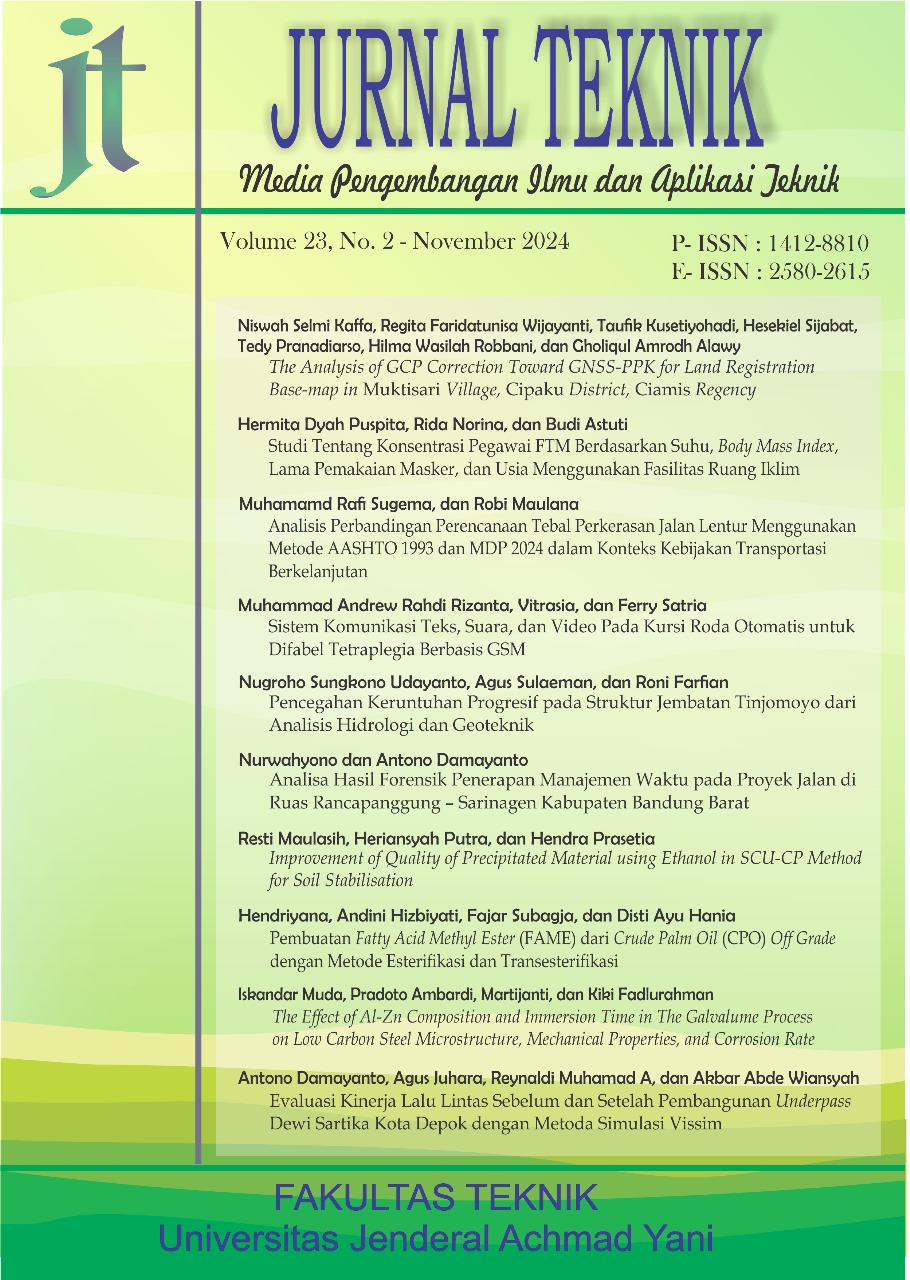
Sistem Komunikasi Teks, Suara, dan Video Pada Kursi Roda Otomatis untuk Difabel Tetraplegia Berbasis GSM
DOI:
https://doi.org/10.55893/jt.vol23no2.657Keywords:
Assistive Device, Wheelchair, GSM, Voice Commands, MicrocontrollerAbstract
A wheelchair is an essential mobility aid for individuals facing physical challenges or health issues that hinder their ability to walk. While most people use a wheelchair due to leg problems, some require it because of limitations in other parts of the body, such as the hands or even total paralysis (Tetraplegia). A voice-controlled wheelchair has been developed to enhance independence and improve the quality of life for individuals with such disabilities. Utilizing microcontroller and GSM technology, this wheelchair allows users to control it through voice commands, providing a solution for those with limited mobility without relying on other limbs. Testing showed that the messaging and call functions using the GSM module had an average response time of 8 seconds with a 100% success rate, although the response speed is affected by signal quality. The GPS module demonstrated high accuracy with a deviation of only 0.1 meters from the reference point. These results indicate that this wheelchair not only enhances mobility but also provides the capability for full participation in daily life, supporting better social interaction for its users.
References
Allen, D. D., & Spruill, L. (2020). Evaluating the Effectiveness of GSM-Based Communication Tools for Disabled Users. Journal of Assistive, Rehabilitative, and Therapeutic Technologies, 11(2), 87-99. https://doi.org/10.1080/1559675X.2020.1748925
Chandrasekaran, S., Lee, B. S., & Kim, H. (2019). Smart Wheelchairs: State-of-the-Art and Future Directions. Robotics and Autonomous Systems, 121, 103273. https://doi.org/10.1016/j.robot.2019.103273
Computational Interaction and Robotics Laboratory. (2024). Assistive Technologies for Quadriplegics. Johns Hopkins University. Diakses dari CIRL.
Eapen, B. C., Pease, W. S., & Watanabe, T. K. (202 (Laboratory, 2024)3). Communication and spinal cord injury. Spinal Cord Injury, 4(3), 245-256. https://doi.org/10.1016/j.sci.2023.02.001
Garcia, M., Sanchez, J., & Rodriguez, P. (2019). User-Centered Design of Assistive Devices for Tetraplegics: Challenges and Solutions. Disability and Rehabilitation: Assistive Technology, 14(3), 265-278. https://doi.org/10.1080/17483107.2018.1492283
García-Moreno, C., Ventura, S., & González, A. (2022). Advances in Assistive Technology for Quadriplegia: A Comprehensive Review. Disability and Rehabilitation: Assistive Technology, 17(2), 112-125. https://doi.org/10.1080/17483107.2021.1897762
Johnson, R., Kim, S., & Thompson, M. (2018). Integrating GSM Technology in Assistive Devices for Improved Accessibility. Assistive Technology, 30(3), 132-140. https://doi.org/10.1080/10400435.2018.1428431
Kaur, H., Singh, J., & Aggarwal, V. (2022). The Impact of Voice-Controlled Systems on the Independence of People with Disabilities. International Journal of Human-Computer Interaction, 38(6), 490-500. https://doi.org/10.1080/10447318.2021.2002147
Kumar, R., Singh, S., & Gupta, A. (2022). Augmentative and Alternative Communication Technologies for Spinal Cord Injury Patients. Journal of Rehabilitation Engineering, 29(1), 45-58. https://doi.org/10.323/jre.2022.001
Lazaro, R. T., Anderson, A. J., & Brown, M. C. (2020). Traumatic spinal cord injury. In T. Umphred & R. Lazaro (Eds.), Umphred's Neurological Rehabilitation (7th ed., pp. 650-668). Elsevier. https://www.clinicalkey.com
Lee, C., Kim, D., & Park, G. (2020). Development of Smart Home Systems for Individuals with Severe Disabilities. International Journal of Human-Computer Interaction, 36(5), 450-465. https://doi.org/10.1080/10447318.2020.1715843
Mayo Clinic. (2024). Assistive technology for spinal cord injury. Mayo Clinic. https://www.mayoclinic.org
Martínez, J. M., Muñoz, V., & Carrillo, J. (2020). Enhancing Mobility for Tetraplegic Individuals through Smart Assistive Technologies. Sensors, 20(11), 3217. https://doi.org/10.3390/s20113217
Morone, G., Paolucci, S., & Iosa, M. (2023). Development and use of assistive technologies in spinal cord injury: A narrative review of reviews on the evolution, opportunities and bottlenecks of their integration in the health domain. Healthcare, 11(3), 452-467. https://doi.org/10.3390/healthcare11111646
Müller, R., Schuster-Amft, C., & Cieza, A. (2021). User-Centered Design of Assistive Devices for Tetraplegics: Challenges and Solutions. Disability and Health Journal, 14(1), 100965. https://doi.org/10.1016/j.dhjo.2020.100965
Patel, P., Smith, D., & Jones, K. (2021). Wearable Technology for Enhancing Mobility and Communication in Tetraplegia: A Systematic Review. Journal of Assistive Technologies, 18(4), 320-335. https://doi.org/10.1108/JAT-09-2020-0045
Raman, R., Patel, H., & Kothari, A. (2021). The Role of Microcontrollers in Developing Smart Wheelchairs for Disabled Users. IEEE Access, 9, 15830-15838. https://doi.org/10.1109/ACCESS.2021.3050634
Smith, J. A. (2019). Communication and Mobility Solutions for Individuals with Tetraplegia. Journal of Rehabilitation Research and Development, 56(4), 645-657. https://www.rehab.research.va.gov
Thompson, L., Johnson, A., & Davis, M. (2023). Robotic Assistance in Daily Living for Individuals with Tetraplegia: A Review. Robotics and Autonomous Systems, 45, 210-225. https://doi.org/10.1016/j.robot.2023.04.005
Ventura, S., García-Moreno, C., & González, A. (2023). Acceptance of assistive technology by users with motor disabilities due to spinal cord or acquired brain injuries: A systematic review. Journal of Clinical Medicine, 12(3), 285-300. https://doi.org/10.3390/jcm12082962
Additional Files
Published
Issue
Section
License
Copyright (c) 2025 Muhammad Andrew Rahdi Rizanta, Vitrasia, Ferry Satria

This work is licensed under a Creative Commons Attribution 4.0 International License.
Authors retain copyright and grant Jurnal Teknik: Media Pengembangan Ilmu dan Aplikasi Teknik the right of first publication. Articles are published open access under the Creative Commons Attribution 4.0 International License (CC BY 4.0), which permits use, sharing, adaptation, distribution, and reproduction in any medium or format, for any purpose, provided that appropriate credit is given to the original authors and source, a link to the license is provided, and any changes are indicated.