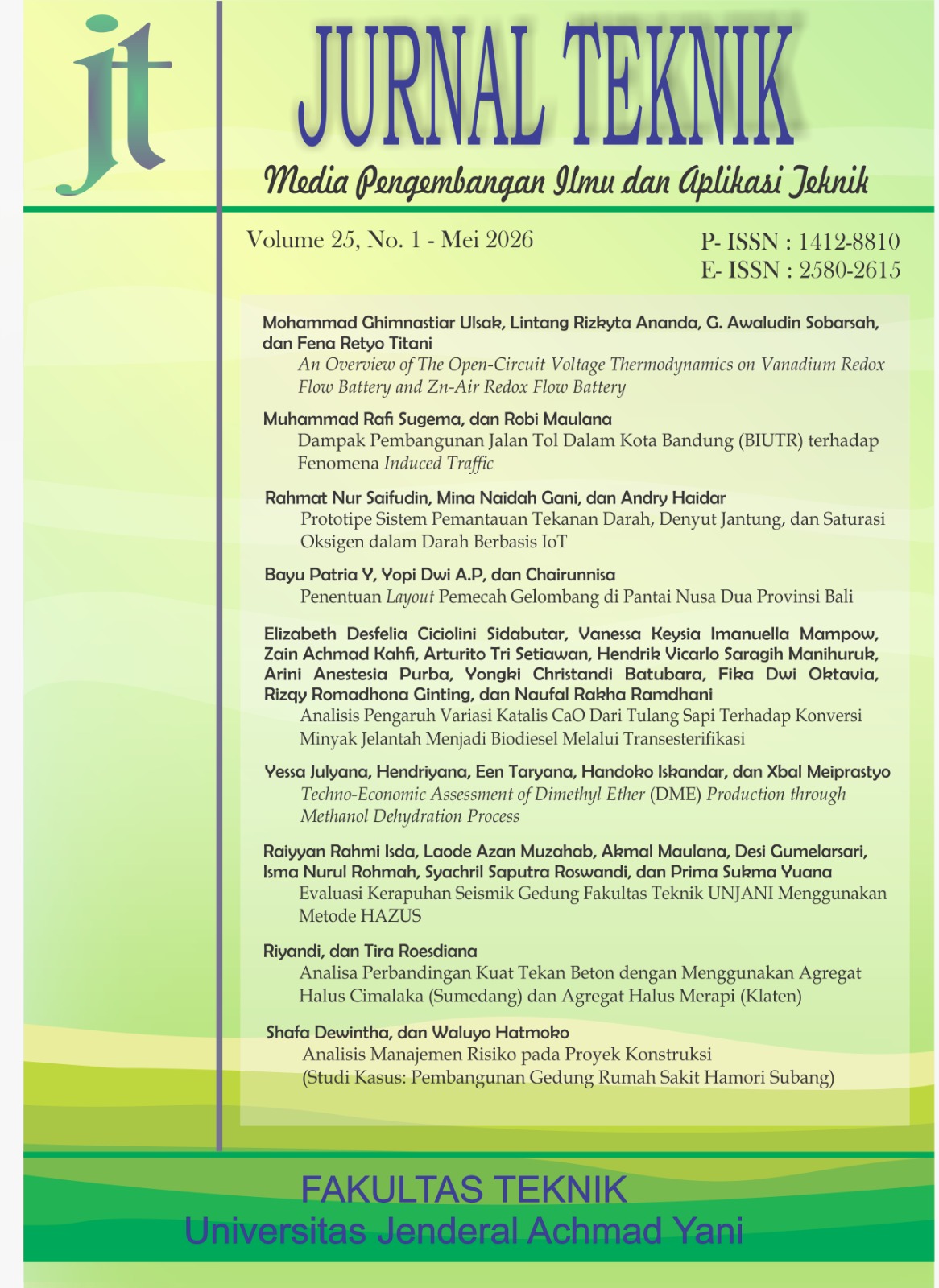
An Overview of The Open-Circuit Voltage Thermodynamics on Vanadium Redox Flow Battery and Zn-Air Redox Flow Battery
DOI:
https://doi.org/10.55893/jt.vol25no1.795Kata Kunci:
Baterai Aliran Redoks, Tegangan Sirkuit Terbuka, Termodinamika, Baterai Aliran Redoks Vanadium, Baterai Zn-UdaraAbstrak
Persamaan Nernst untuk tegangan sirkuit terbuka, yang pertama kali dikembangkan oleh Walther Nernst lebih dari seabad yang lalu, sangat penting dalam studi sistem elektrokimia. Sayangnya, ketika diterapkan pada sistem yang kompleks (seperti yang menggunakan membran pertukaran ion atau melibatkan potensial campuran), persamaan ini dapat mengambil bentuk yang salah karena asumsi yang mendasari derivasi persamaan tersebut sering diabaikan dalam literatur. Terlepas dari cara proses elektrokimia diekspresikan, kesalahan-kesalahan ini dapat dicegah dengan menggunakan derivasi termodinamika yang akurat. Misalnya, pemodelan baterai aliran redoks vanadium dan baterai zinc-air memerlukan derivasi yang benar dari persamaan Nernst. Termodinamika non-kesetimbangan adalah titik awal yang ketat untuk derivasi persamaan Nernst.
Referensi
Abbasi, A., Hosseini, S., Somwangthanaroj, A., Mohamad, A. A., & Kheawhom, S. (2019). Hydroxide Exchange Separator Membranes for Zinc - Air Battery, 1, 1-17.
Baes, C. F., & Mesmer, R. E. (1976). The Hydrolysis of Cations. Wiley. Retrieved from https://books.google.co.id/books?id=CgnwAAAAMAAJ
Bard, A. J., Parsons, R., & Jordan, J. (1985). Standard Potentials in Aqueous Solution. Taylor & Francis. Retrieved from https://books.google.co.id/books?id=fuJV1H18KtEC
Cachet, C., Stroder, U., & Wiart, R. (1982). The kinetics of zinc electrode in alkaline zincate electrolytes. Electrochimica Acta, 27(7), 903-908. https://doi.org/10.1016/0013-4686(82)80214-4
Chen, L., & Lasia, A. (1991). Study of the Kinetics of Hydrogen Evolution Reaction on Nickel-Zinc Alloy Electrodes. Journal of The Electrochemical Society, 138(11), 3321-3328. https://doi.org/10.1149/1.2085409
De Groot, S. R., & Mazur, P. (2013). Non-Equilibrium Thermodynamics. Dover Publications. Retrieved from https://books.google.co.id/books?id=mfFyG9jfaMYC
Dean, J. A., & Lange, N. A. (1999). Lange's Handbook of Chemistry. McGraw-Hill. Retrieved from https://books.google.co.id/books?id=56KPMQEACAAJ
Deiss, E., Holzer, F., & Haas, O. (2002). Modeling of an electrically rechargeable alkaline Zn-air battery. Electrochimica Acta, 47(25), 3995-4010. https://doi.org/10.1016/S0013-4686(02)00316-X
Dewi, E. L., Oyaizu, K., Nishide, H., & Tsuchida, E. (2003). Cationic polysulfonium membrane as separator in zinc-air cell. Journal of Power Sources, 115(1), 149-152. https://doi.org/10.1016/S0378-7753(02)00650-X
Dreyer, W., Guhlke, C., & Muller, R. (2016). A new perspective on the electron transfer: Recovering the Butler-Volmer equation in non-equilibrium thermodynamics. Physical Chemistry Chemical Physics, 18(36), 24966-24983. https://doi.org/10.1039/c6cp04142f
Dundalek, J., Snajdr, I., Libansky, O., Vrana, J., Pocedic, J., Mazur, P., & Kosek, J. (2017). Zinc electrodeposition from flowing alkaline zincate solutions: Role of hydrogen evolution reaction. Journal of Power Sources, 372(October), 221-226. https://doi.org/10.1016/j.jpowsour.2017.10.077
Fujiwara, N., Yao, M., Siroma, Z., Senoh, H., Ioroi, T., & Yasuda, K. (2011). Reversible air electrodes integrated with an anion-exchange membrane for secondary air batteries. Journal of Power Sources, 196(2), 808-813. https://doi.org/10.1016/j.jpowsour.2010.07.074
Gnutt, D., Heyden, M., & Ebbinghaus, S. (2016). Physical Chemistry 2015. Nachrichten Aus Der Chemie, 64(3), 310-313. https://doi.org/10.1002/nadc.20164047296
Gubeli, A. O., & Ste-Marie, J. (1967). Stabilite des complexes hydroxo et produits de solubilite des hydroxydes de metaux. I. Argent et zinc. Canadian Journal of Chemistry, 45(8), 827-832. https://doi.org/10.1139/v67-137
Guggenheim, E. A. (1985). Thermodynamics - An advanced treatment for chemists and physicists (7th edition).
Hamann, C. H. (2007). Electrochemistry. WILEY-VCH (NY). Retrieved from https://books.google.co.id/books?id=A8nIzgEACAAJ
Huynh, T. T. K., Yang, T., Nayanthara, P. S., Yang, Y., Ye, J., & Wang, H. (2025). Construction of High-Performance Membranes for Vanadium Redox Flow Batteries: Challenges, Development, and Perspectives. Nano-Micro Letters (Vol. 17). Springer Nature Singapore. https://doi.org/10.1007/s40820-025-01736-x
Hwang, G.-J., & Ohya, H. (1996). Preparation of cation exchange membrane as a separator for the all-vanadium redox flow battery. Journal of Membrane Science, 120(1), 55-67. https://doi.org/10.1016/0376-7388(96)00135-4
Hwang, G.-J., & Ohya, H. (1997). Crosslinking of anion exchange membrane by accelerated electron radiation as a separator for the all-vanadium redox flow battery. Journal of Membrane Science, 132(1), 55-61. https://doi.org/10.1016/S0376-7388(97)00040-9
Isaacson, M. J., McLarnon, F. R., & Cairns, E. J. (1990). Zinc Electrode Rest Potentials in Concentrated KOH - K2Zn(OH)4 Electrolytes. Journal of The Electrochemical Society, 137(8), 2361-2364. https://doi.org/10.1149/1.2086944
Jinnouchi, R., Karsai, F., & Kresse, G. (2024). Absolute standard hydrogen electrode potential and redox potentials of atoms and molecules: Machine learning aided first principles calculations. Chemical Science, 16(5), 2335-2343. https://doi.org/10.1039/d4sc03378g
Kim, H., Kim, M. M., Cho, J., Lee, S., Kim, D. H., Shin, S. J., ... Choi, C. H. (2025). Cation Effect on the Electrochemical Platinum Dissolution. Journal of the American Chemical Society, 147(5), 4667-4674. https://doi.org/10.1021/jacs.4c17833
Kjelstrup, S., & Bedeaux, D. (2008). Non-equilibrium Thermodynamics of Heterogeneous Systems. Series on Advances in Statistical Mechanics. Retrieved from https://api.semanticscholar.org/CorpusID:91721720
Knehr, K. W., & Kumbur, E. C. (2011). Open circuit voltage of vanadium redox flow batteries: Discrepancy between models and experiments. Electrochemistry Communications, 13(4), 342-345. https://doi.org/10.1016/j.elecom.2011.01.020
Kobets, S. O., Pshynko, G. M., Yatsyk, B. P., & Demutska, L. M. (2025). Promising Adsorbents for the Purification of Aquatic Environments from Heavy Metals: A Review. Journal of Water Chemistry and Technology, 47(5), 476-491. https://doi.org/10.3103/S1063455X25050066
Lenihan, C., Oboroceanu, D., Quill, N., Ni Eidhin, D., Bourke, A., Lynch, R. P., & Buckley, D. N. (2018). Water Affinity of Vanadium Electrolytes. ECS Transactions, 85(13), 175-189. https://doi.org/10.1149/08513.0175ecst
Mor, B. (2025). The Conceptual Flow of Physics: A Transdisciplinary Framework for Modern Science. Transdisciplinary Journal of Engineering and Science, 16, 209-233. https://doi.org/10.22545/2025/00277
Munoz, C. A. P., Dewage, H. H., Yufit, V., & Brandon, N. P. (2017). A Unit Cell Model of a Regenerative Hydrogen-Vanadium Fuel Cell. Journal of The Electrochemical Society, 164(14), F1717-F1732. https://doi.org/10.1149/2.1431714jes
Newman, J., & Thomas-Alyea, K. E. (2004). Electrochemical Systems. Wiley. Retrieved from https://books.google.co.id/books?id=vArZu0HM-xYC
Pavelka, M., Klika, V., & Grmela, M. (2018). Multiscale Thermo-Dynamics. Multiscale Thermo-Dynamics, (December 2019). https://doi.org/10.1515/9783110350951
Pavelka, M., Klika, V., Vagner, P., & Marsik, F. (2015). Generalization of exergy analysis. Applied Energy, 137(March 2020), 158-172. https://doi.org/10.1016/j.apenergy.2014.09.071
Pavelka, M., Wandschneider, F., & Mazur, P. (2015). Thermodynamic derivation of open circuit voltage in vanadium redox flow batteries. Journal of Power Sources, 293, 400-408. https://doi.org/10.1016/j.jpowsour.2015.05.049
Perez, N. (2007). Electrochemistry and Corrosion Science. Springer US. Retrieved from https://books.google.co.id/books?id=nynrBwAAQBAJ
Powell, K. J., Brown, P. L., Byrne, R. H., Gajda, T., Hefter, G., Leuz, A. K., ... Wanner, H. (2009). Chemical speciation of environmentally significant metals with inorganic ligands. Part 3: The Pb2+, OH-, Cl-, CO3 2-, SO4 2-, and PO4 3- systems (IUPAC Technical Report). Pure and Applied Chemistry, 81(12), 2425-2476. https://doi.org/10.1351/PAC-REP-09-03-05
Reed, J. J. (2020). Digitizing "The NBS tables of chemical thermodynamic properties: Selected values for inorganic and c1 and c2 organic substances in SI Units"1. Journal of Research of the National Institute of Standards and Technology. https://doi.org/10.6028/JRES.125.007
Ren, B., Zhang, X., Wei, H., Jiang, J., Chen, G., Li, H., & Liu, Z. (2025). Suppressing Zinc Metal Corrosion by an Effective and Durable Corrosion Inhibitor for Stable Aqueous Zinc Batteries. Advanced Functional Materials, 35(17), 2418594. https://doi.org/10.1002/adfm.202418594
Schroder, D., & Krewer, U. (2014). Model based quantification of air-composition impact on secondary zinc air batteries. Electrochimica Acta, 117, 541-553. https://doi.org/10.1016/j.electacta.2013.11.116
Sellathurai, A. J., Khademi, M., Zhang, B. X., Al-Hamdani, M., & Barz, D. P. J. (2025). Mitigation of Dendrite Formation on Zinc Electrodes in Mildly Acidic Electrolytes: The Influence of Self-Assembled Graphene Surface Coatings and Electrolyte Additives. Langmuir, 41(29), 19204-19217. https://doi.org/10.1021/acs.langmuir.5c01550
Skyllas-Kazacos, M., & Kazacos, M. (2011). State of charge monitoring methods for vanadium redox flow battery control. Journal of Power Sources, 196(20), 8822-8827. https://doi.org/10.1016/j.jpowsour.2011.06.080
Stamm, J., Varzi, A., Latz, A., & Horstmann, B. (2017). Modeling nucleation and growth of zinc oxide during discharge of primary zinc-air batteries. Journal of Power Sources, 360, 136-149. https://doi.org/10.1016/j.jpowsour.2017.05.073
Sukkar, T., & Skyllas-Kazacos, M. (2003). Water transfer behaviour across cation exchange membranes in the vanadium redox battery. Journal of Membrane Science, 222(1), 235-247. https://doi.org/10.1016/S0376-7388(03)00309-0
Sun, M., Wan, K., Huang, Y., Yang, H., Zhou, X., Yan, C., ... Qian, T. (2025). Playing with Water Molecules: "Repulsing" or "Trapping" to Exclude Water-Induced Side Reactions on Zn Metal Anode. Advanced Functional Materials, 35(13), 2417890. https://doi.org/10.1002/adfm.202417890
Tsehaye, M. T., Alloin, F., & Iojoiu, C. (2019). Prospects for anion-exchange membranes in alkali metal-air batteries. Energies, 12(24). https://doi.org/10.3390/en12244702
Vagner, P., Kodym, R., & Bouzek, K. (2019). Thermodynamic analysis of high temperature steam and carbon dioxide systems in solid oxide cells. Sustainable Energy and Fuels, 3(8), 2076-2086. https://doi.org/10.1039/c9se00030e
Vlasov, V. I., Kuzin, A. Y., Florya, I. N., Buriak, N. S., Chernyshev, V. S., Golikov, A. D., ... Gorin, D. A. (2025). Hybrid nanophotonic-microfluidic sensor integrated with machine learning for operando state-of-charge monitoring in vanadium flow batteries. Journal of Energy Storage, 111(August 2024), 115349. https://doi.org/10.1016/j.est.2025.115349
Wang, C. R., Stansberry, J. M., Mukundan, R., Chang, H.-M. J., Kulkarni, D., Park, A. M., ... Zenyuk, I. V. (2025). Proton Exchange Membrane (PEM) Water Electrolysis: Cell-Level Considerations for Gigawatt-Scale Deployment. Chemical Reviews, 125(3), 1257-1302. https://doi.org/10.1021/acs.chemrev.3c00904
Zelger, C., Sussenbacher, M., Laskos, A., & Gollas, B. (2019). State of charge indicators for alkaline zinc-air redox flow batteries. Journal of Power Sources, 424, 76. https://doi.org/10.1016/j.jpowsour.2019.03.099
Zhang, B., & Lei, Y. (2025). Simulation of the electrolyte imbalance in vanadium redox flow batteries. PLoS ONE, 20(2 February). https://doi.org/10.1371/journal.pone.0318460
Zhang, C., Wang, J., Zhang, L., Zhang, J., & Cao, C. (2001). The Behavior of the Amalgamated Zinc Electrode in Supersaturated Alkaline Zincate Solutions. Journal of The Electrochemical Society - J ELECTROCHEM SOC, 148. https://doi.org/10.1149/1.1374447
Zhang, J., Tang, Y., Song, C., Zhang, J., & Wang, H. (2006). PEM fuel cell open circuit voltage (OCV) in the temperature range of 23 degC to 120 degC. Journal of Power Sources, 163(1 SPEC. ISS.), 532-537. https://doi.org/10.1016/j.jpowsour.2006.09.026
Zhang, X. G. (1996). Corrosion and Electrochemistry of Zinc. Springer US. Retrieved from https://books.google.co.id/books?id=Qmf4VsriAtMC
Zhang, Y., & Muhammed, M. (2001). Critical evaluation of thermodynamics of complex formation of metal ions in aqueous solutions VI. Hydrolysis and hydroxo-complexes of Zn2+ at 298.15 K. Hydrometallurgy, 60, 215-236. https://doi.org/10.1016/S0304-386X(01)00148-7
Zhen, C., Hiratsuka, N., Chiku, M., Higuchi, E., & Inoue, H. (2025). Zinc Deposition Behavior in Concentrated Aqueous Potassium Hydroxide Solutions. ACS Applied Energy Materials, 8(13), 9268-9279. https://doi.org/10.1021/acsaem.5c00852
File Tambahan
Diterbitkan
Terbitan
Bagian
Lisensi
Hak Cipta (c) 2026 Mohammad Ghimnastiar Ulsak, Lintang Rizkyta Ananda, G. Awaludin Sobarsah, Fena Retyo Titani

Artikel ini berlisensiCreative Commons Attribution-NonCommercial-ShareAlike 4.0 International License.
Penulis yang menyerahkan artikel di Jurnal Teknik: Media Pengembangan dan Aplikasi Teknik untuk keperluan publikasi telah mengetahui bahwa Jurnal Teknik: Media Pengembangan dan Aplikasi Teknik memberikan akses terbuka terhadap konten untuk mendukung pertukaran informasi mengenai ilmu pengetahuan, sesuai dengan penerbitan daring yang berbasis Open Access Journal dan mengikuti Creative Commons Attribution 4.0 International License. Sehingga penulis setuju dengan ketentuan-ketentuan berikut:
1. Penulis memegang hak cipta dan memberikan hak publikasi pertama kepada pihak jurnal dengan pekerjaan secara bersamaan
di bawah Creative Commons Attribution 4.0 International License yang memungkinkan orang lain untuk berbagi pekerjaan
dengan pengakuan kepengarangan karya dan publikasi pertama artikel tersebut di Jurnal Teknik: Media Pengembangan dan
Aplikasi Teknik.
2. Penulis dapat melakukan perjanjian tambahan untuk hak distribusi non-eksklusif artikel yang telah diterbitkan di jurnal ini
(misalnya, posting ke sebuah repositori institusi atau menerbitkannya dalam sebuah buku), dengan mengakui bahwa
publikasi pertama dilakukan di Jurnal Teknik: Media Pengembangan dan Aplikasi Teknik.
3. Penulis diizinkan dan didorong untuk menyebarkan karya mereka secara daring (misalnya, dalam repositori institusi atau
laman web penulis) setelah artikel terbit (proses penerbitan artikel selesai). Hal ini terkait dengan imbas dari pertukaran
informasi yang produktif (Lihat Pengaruh Open Access).