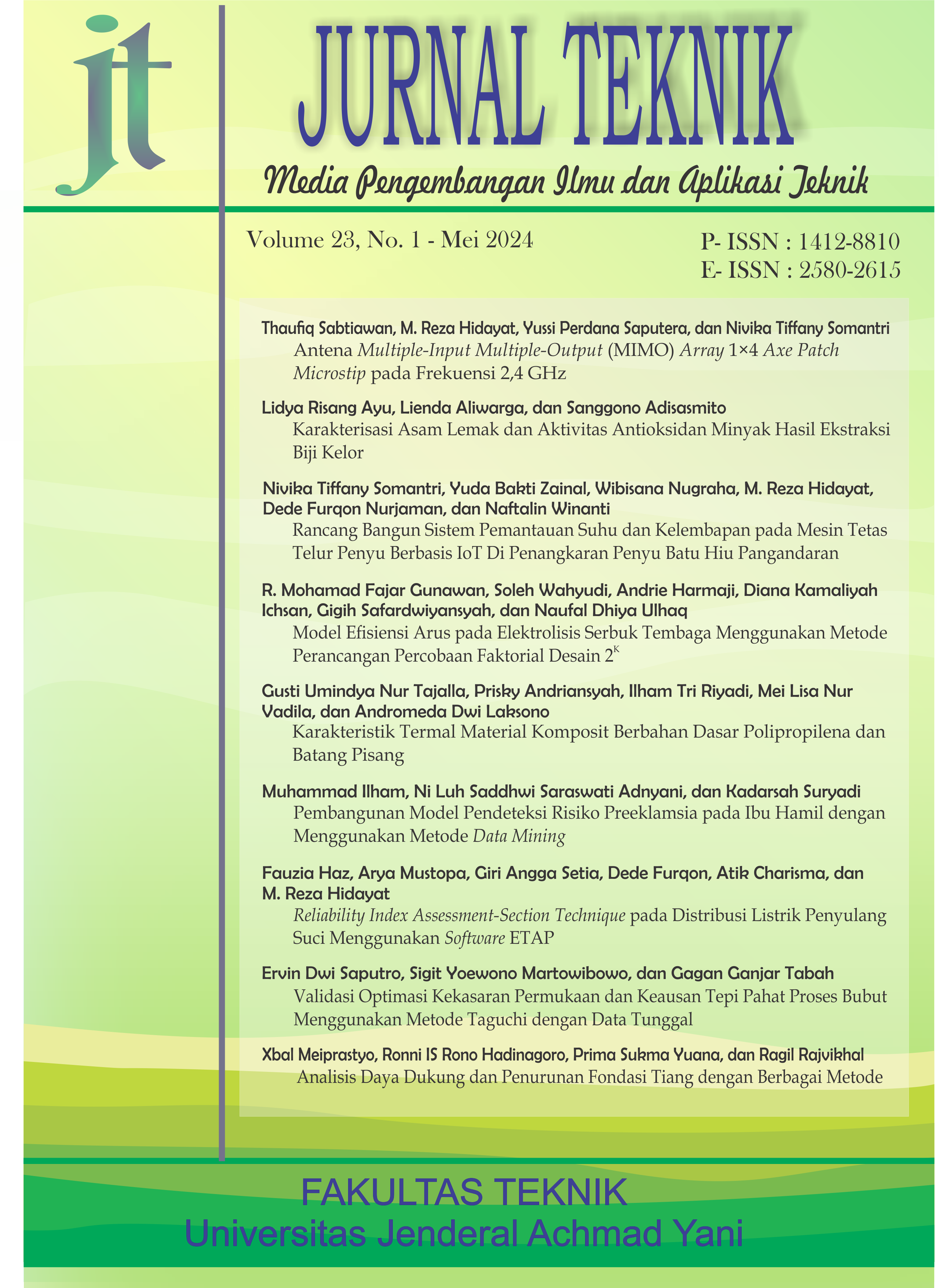
Validasi Optimasi Kekasaran Permukaan dan Keausan Tepi Pahat Proses Bubut Menggunakan Metode Taguchi dengan Data Tunggal
DOI:
https://doi.org/10.55893/jt.vol23no1.620Keywords:
Optimization , Taguchi method, S/N analysis, Standard analysis, Turning processesAbstract
The Taguchi method uses signal-to-noise ratio (S/N) analysis to obtain optimal values and requires repeated data collection combined with control factors. However, in practice, the Taguchi method is still not in accordance with this concept, even though there are standard analysis options that do not require repeated data collection. In this study, a validation study of the Taguchi method was conducted for the case of a single data collection by comparing the optimization results obtained against standard analysis and validation experiment results. Determination of validity is carried out based on four comparison parameters, namely the combination of control factors, prediction of optimum value, deviation of optimum value prediction, and ranking of control factor influence. This research was conducted using a turning process case study. From this research, it is concluded that the Taguchi method for optimization of a single data collection is valid.
References
Aamir, M., Tu, S., Tolouei-Rad, M., Giasin, K., & Vafadar, A. (2020). Optimization and Modeling of Process Parameters in Multi-hole Simultaneous Drilling Using Taguchi Method and Fuzzy Logic Approach. Materials, 13(3), 680. httpss://doi.org/10.3390/ma13030680
Berube, J., & Wu, C. F. J. (2000). Signal-to-Noise Ratio and Related Measures in Parameter Design Optimization: An Overview. Sankhya: The Indian Journal of Statistics, 62(3), 417–432. https://doi.org/10.2307/25053155
Bhaduria, O. S., Goyal, S., & Chauhan, P. S. (2016). Application of Taguchi Method for Optimization of Process Parameters for Minimum Surface Roughness in Turning of 45C8. International Journal of Current Engineering and Scientific Research, 3(1), 61–68.
Galaxy Machinery. (2017). Midas 6. Galaxy Machinery PVT. Ltd. http://www.galaxymachinery.com/Midas6.html
Hutahaean, H. A. (2005). Metode Taguchi-Diktat Kuliah. Jurusan Teknik Industri, Fakultas Teknik, Universitas Atma Jaya.
Jenarthanan, M. P., & Jeyapaul, R. (2013). Optimisation of Machining Parameters on Milling of GFRP Composites by Desirability Function Analysis Using Taguchi Method. International Journal of Engineering, Science and Technology, 5(4), 23–36. https://doi.org/10.4314/ijest.v5i4.3
Kalpakjian, S., & Schmid, S. R. (2009). Manufacuring Engineering and Technology. Pearson Education.
Kaswadi, A., Lubis, G. S., & Martowibowo, S. . (2015). Optimalisasi Parameter Proses Cetak Injeksi Plastik dengan Metode Simulasi untuk Menurunkan Cacat Defleksi. Prosiding Seminar Nasional Tahunan Teknik Mesin XIV (SNTTM XIV), MAN-01.
Lan, T. S., Chuang, K. C., & Chen, Y. M. (2018). Optimization of Machining Parameters using Fuzzy Taguchi Method for Reducing Tool Wear. Applied Sciences, 8(7), 1011. https://doi.org/10.3390/app8071011
Manivel, D., & Gandhinathan, R. (2016). Optimization of Surface Roughness and Tool Wear in Hard Turning of Austempered Ductile Iron (grade 3) Using Taguchi Method. Measurement, 93, 108–116. https://doi.org/10.1016/j.measurement.2016.06.055
Martowibowo, S. Y., & Wahyudi, A. (2012). Taguchi Method Implementation in Taper Motion Wire EDM Process Optimization. Journal of The Institution of Engineers (India): Series C, 93(4), 357–364. https://doi.org/10.1007/s40032-012-0043-z
Patel, N. S., Parihar, P. L., & Makwana, J. S. (2021). Parametric Optimization to Improve the Machining Process by Using Taguchi Method: A Review. Materials Today: Proceedings, 47(11), 2709–2714. https://doi.org/10.1016/j.matpr.2021.03.005
Rao, S. S. (2009). Engineering Optimization Theory and Practice (4th ed.). John Wiley & Sons.
Ribeiro, J. E., César, M. B., & Lopes, H. (2017). Optimization of Machining Parameters to Improve the Surface Quality. Procedia Structural Integrity, 5(5), 355–362. https://doi.org/10.1016/j.prostr.2017.07.182
Rochim, T. (2007). Klasifikasi, Proses, Gaya, dan Daya Permesinan. Penerbit ITB.
Roy, R. K. (2010). A Primer on the Taguchi Method (2nd ed.). Society of Manufacturing Engineers.
Singh, K., & Sultan, I. (2019). Parameters Optimization for Sustainable Machining by Using Taguchi Method. Materials Today: Proceedings, 18(7), 4217–4226. https://doi.org/10.1016/j.matpr.2019.07.380
Soejanto, I. (2009). Desain Eksperimen dengan Metode Taguchi. Graha Ilmu.
Somani, N., Tyagi, Y. K., & Kumar, P. (2021). Effect of Process Parameters on Machining of D2 Steel Using Taguchi Method. Recent Trends in Industrial and Production Engineering, 67–78. https://doi.org/10.1007/978-981-16-3135-1_8
Sulaiman, S., Sh Alajmi, M., Wan Isahak, W. N., Yusuf, M., & Sayuti, M. (2022). Dry Milling Machining: Optimization of Cutting Parameters Affecting Surface Roughness of Aluminum 6061 Using the Taguchi Method. International Journal of Technology (IJTech), 13(1), 58–68.
Taguchi, G. (1986). Introduction to Quality Engineering-Designing Quality into Products and Processes. Asian Productivity Organization.
Taguchi, G., Chowdhury, S., & Wu, Y. (2005). Taguchi’s Quality Engineering Handbook (2nd ed.). John Wiley & Sons.
Thirumalai, R., Senthilkumaar, J. S., Selvarani, P., & Ramesh, S. (2013). Machining Characteristics of Inconel 718 Under Several Cutting Conditions Based on Taguchi Method. Proceedings of the Institution of Mechanical Engineers, Part C: Journal of Mechanical Engineering Science, 227(9), 1889–1897. https://doi.org/10.1177/0954406212466193
Additional Files
Published
Issue
Section
License
Copyright (c) 2024 Ervin, Sigit Yoewono Martowibowo, Gagan

This work is licensed under a Creative Commons Attribution 4.0 International License.
Authors retain copyright and grant Jurnal Teknik: Media Pengembangan Ilmu dan Aplikasi Teknik the right of first publication. Articles are published open access under the Creative Commons Attribution 4.0 International License (CC BY 4.0), which permits use, sharing, adaptation, distribution, and reproduction in any medium or format, for any purpose, provided that appropriate credit is given to the original authors and source, a link to the license is provided, and any changes are indicated.