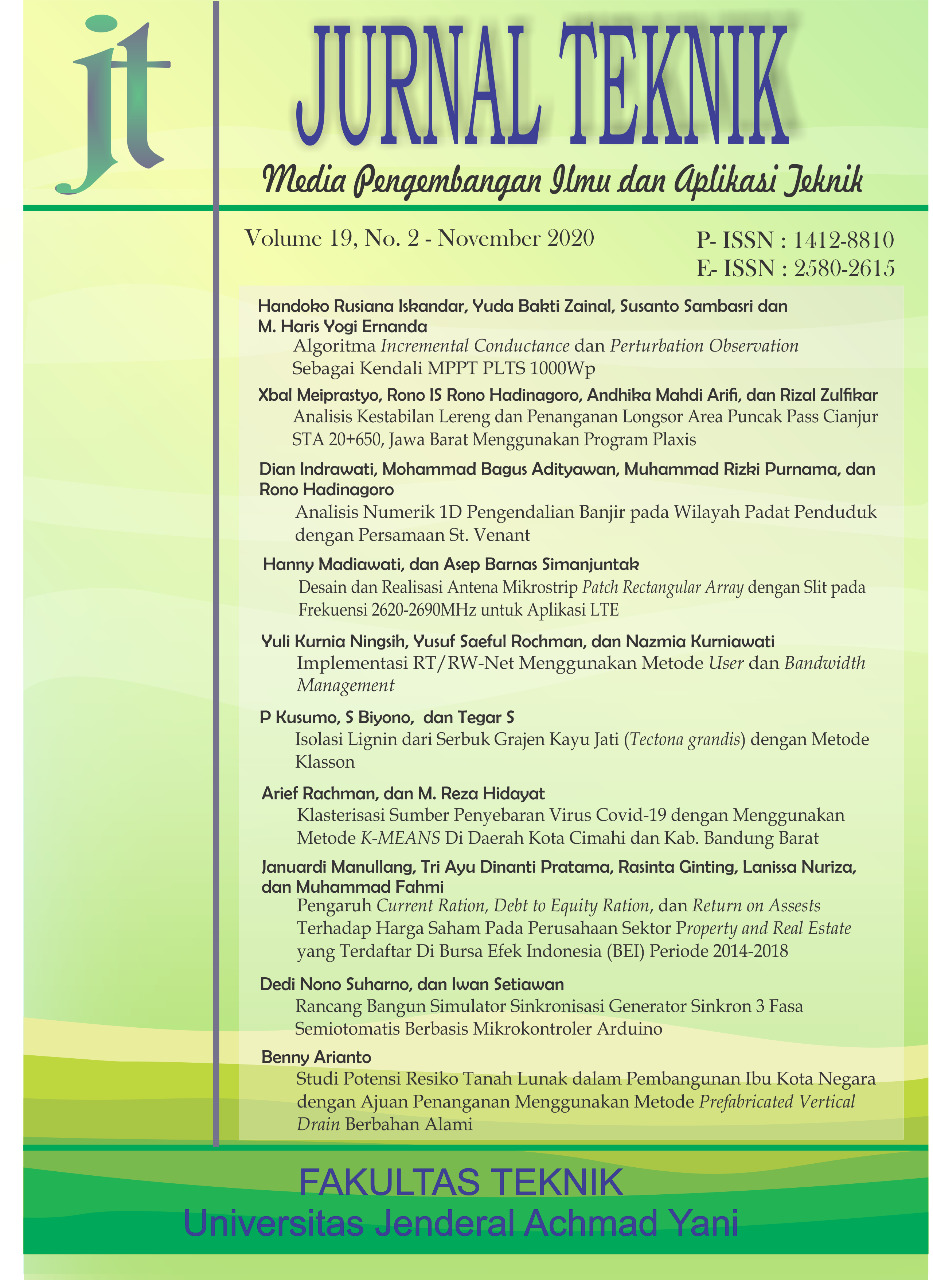
Klasterisasi Sumber Penyebaran Virus Covid-19 dengan Menggunakan Metode K-MEANS Di Daerah Kota Cimahi dan Kab. Bandung Barat
DOI:
https://doi.org/10.26874/jt.vol19no02.233Keywords:
Covid-19, Clustering, K-means, WEKAAbstract
The Covid-19 virus originated from the city of Wuhan in China. Transmission is very fast and rapid to various parts of the world including Indonesia. This study discusses the clustering of sources of the spread of the covid-19 virus using the k-means method using software for Cimahi City and West Bandung Regency. The purpose of this study is to obtain information about 5 clusters of the source of the Covid-19 virus, namely cluster 0 (offices), cluster 1 (places to eat), cluster 2 (houses), cluster 3 (shopping), and cluster 4 (public transportation). during May to July 2020 for Cimahi City and West Bandung Regency. The results can be concluded that the highest cluster 0 from Kab. West Bandung with an average of 0,05%, for cluster 1 the highest impact of covid-19 was from Kab. West Bandung with an average of 0,55%, for cluster 2 with an average of 0,02%, for cluster 3 the highest impact of covid-19 was from Kab. West Bandung with an average of 0,04%, for cluster 4 the highest impact of covid-19 was from Cimahi City with an average of 0.79%.
References
Ahmad, A. (2019). Perkembangan Teknologi Komunikasi dan Iinformasi: Akar Revolusi dan Berbagai Standarnya. Jakarta: Dakwah Tabligh, Vol. 13, No. 1.
Asroni, R. A. (2015). Penerapan Metode K-Means Untuk Clustering Mahasiswa Berdasarkan Nilai Akademik Dengan Weka Interface Studi Kasus Pada Jurusan Teknik Informatika UMM Magelang. Magelang: Ilmiah Semesta Teknika.
Benri Melpa Metisen, H. L. (2015). Analisis Clustering Menggunakan Metode K-Means Dalam Pengelompokan Penjualan Produk Pada Swalayan Fadhila. Bengkulu: Media Infotama Vol. 11 No. 2.
COVID-19. (2020, September 26). Retrieved from covid-19: https://covid19.go.id/
Gunawan Abdillah, F. A. (2016). Penerapan Data Mining Pemakaian Air Pelanggan untuk Menentukan Klasifikasi Potensi Pemakaian Air Pelanggan Baru di PDAM Tirta Raharja Menggunakan Algoritma K-Means. Cimahi: Seminar Nasional Teknologi Informasi dan Komunikasi.
Iin Parlina, A. P. (2018). Memanfaatkan Algoritma K-Means Dalam Menentukan Pegawai Yang Layak Mengikuti Asessment Center Untuk Clustering Program SDP. Pematangsiantar: CESS (Journal of Computer Engineering System and Science) Vol. 3 No. 1.
Mardiana, T. (2015). Bag Of Word Clusitering Using WEKA. Yogyakarta: Universitas Gadjah Mada.
Narwati. (2016). Pengelompokan Mahasiswa Menggunakan Algoritma K-Means. Jakarta: Fakultas Teknologi Informasi.
Nurlaila Suci Rahayu Rais, M. M. (2018). Kemajuan Teknologi Informasi Berdampak Pada Generalisasi Unsur Sosial Budaya Bagi Generasi Milenial. Jakarta: Mozaik Vol. X Edisi 2.
Pareza Alam Jusia, F. M. (2019). Clustering Data Untuk Rekomendasi Penentuan Jurusan Perguruan Tinggi Menggunakan Metode K-Means. Jambi: IKRA-ITH Informatika.
Riyani Wulan Sari, A. W. (2018). Implementasi Rapidminer Dengan Metode K-Means (Study Kasus: Imunisasi Campak Pada Balita Berdasarkan Provinsi). Pematangsiantar: KOMIK (Konferensi Nasional Teknologi Informasi dan Komputer) Volume 2, Nomor 1.
Setiawan, Daryanto. (2018). Dampak Perkembangan Teknologi Informasi dan Komunikasi Terhadap Budaya. Deli Serdang: SIMBOLIKA, Vol. 4.
Setiawan, Daryanto. (2018). Impact of Information Technology Development and Communication on Culture. Deli Serdang: SIMBOLIKA.
WEKA. (2020). Retrieved from WEKA: https://dokumen.tips/education/bab-1-pendahuluan-weka.html
Windarto, A. P. (2017). Penerapan Data Mining Pada Ekspor Buah-Buahan Menurut Negara Tujuan Menggunakan K-Means Clustering. Pematangsiantar: Techno.COM, Vol. 16, No. 4.
Zulfah, S. (2016). Pengaruh Perkembangan Teknologi Informasi Lingkungan (Studi Kasus Kelurahan Siti Rejo I Medan). Medan: Universitas Islam Sumatera Utara
Additional Files
Published
Issue
Section
License
Copyright (c) 2020 M. Reza Hidayat, Arief Rachman

This work is licensed under a Creative Commons Attribution 4.0 International License.
Authors retain copyright and grant Jurnal Teknik: Media Pengembangan Ilmu dan Aplikasi Teknik the right of first publication. Articles are published open access under the Creative Commons Attribution 4.0 International License (CC BY 4.0), which permits use, sharing, adaptation, distribution, and reproduction in any medium or format, for any purpose, provided that appropriate credit is given to the original authors and source, a link to the license is provided, and any changes are indicated.