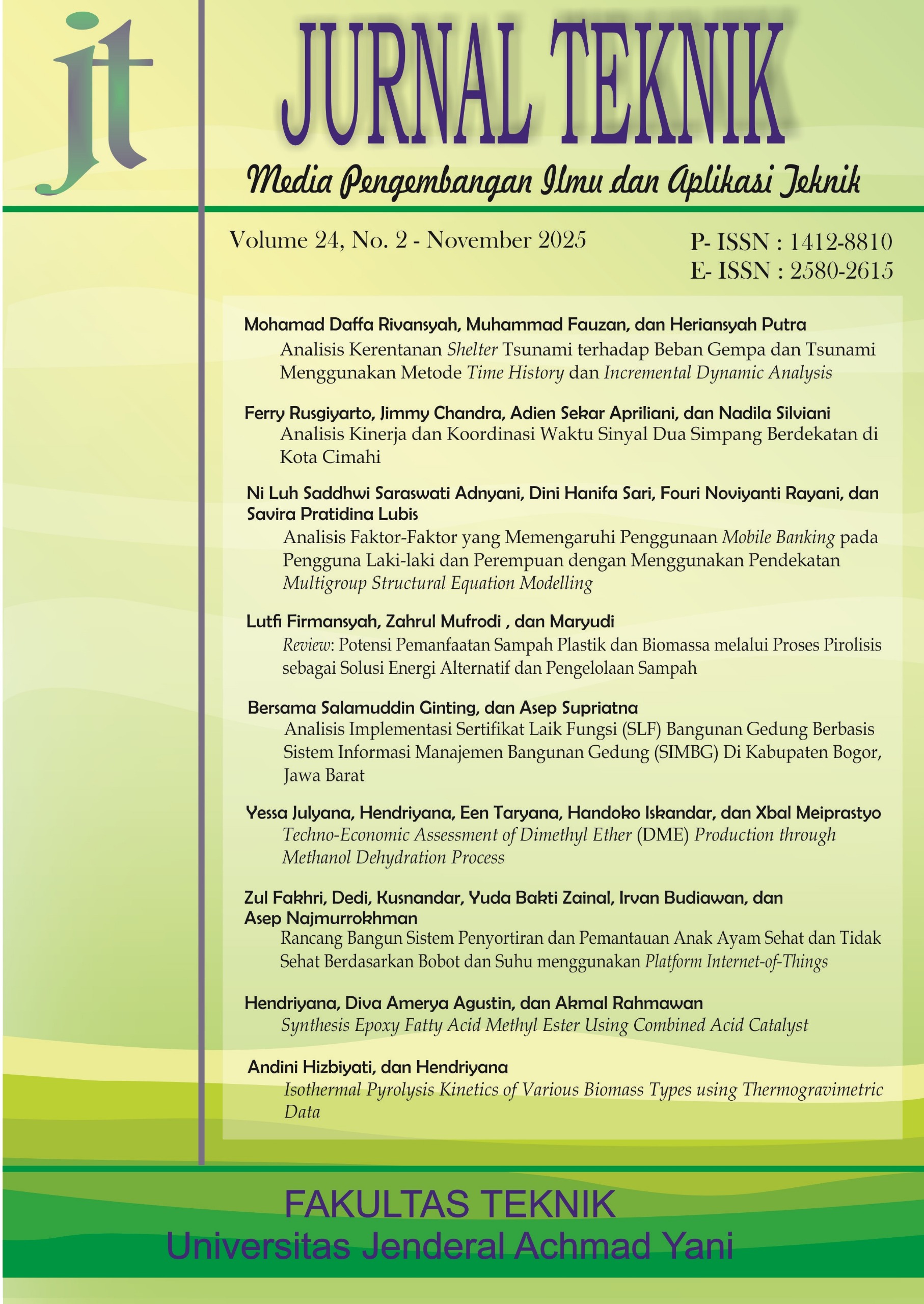
Techno-Economic Assessment of Dimethyl Ether (DME)Production through Methanol Dehydration Process
DOI:
https://doi.org/10.55893/jt.vol24no2.797Keywords:
Dimethyl Ether, Methanol, Techno-Economic AnalysisAbstract
Dimethyl Ether (DME) is a clean, colorless gas that serves as a potential alternative to liquefied petroleum gas (LPG). This study presents a comprehensive techno-economic assessment of DME production via methanol dehydration with a plant capacity of 20,000 tons per year. The process utilizes an alumina–silicate catalyst in a multitube fixed-bed reactor operating at 300–350°C and 30 bar. Simulation results show a methanol conversion of 85% per pass, achieving a final DME purity exceeding 99.5%. The total capital investment (CAPEX) is estimated at USD 12.8 million, with annual operating costs (OPEX) of approximately USD 13 million. Economic indicators reveal a Net Present Value (NPV) of USD 5.2 million, an Internal Rate of Return (IRR) of 14.5%, a Return on Investment (ROI) between 15–17%, and a payback period of six years. The break-even point (BEP) is reached at 60–65% of design capacity. The findings indicate that the DME production process is technically feasible and economically attractive for industrial implementation, supporting Indonesia’s clean energy transition and reduction of LPG imports.
References
Aries, R., & Newton, R. (1955). Chemical Engineering Cost Estimation. McGraw-Hill.
Branan, C. R. (2005). Rules of Thumb for Chemical Engineers (4th ed.). Elsevier.
Coulson, J. M., Richardson, J. F., Backhurst, J. R., & Harker, J. H. (1983). Chemical Engineering: Volume 6 – Design. Pergamon.
Dieterich, V., Neumann, K., Niederdränk, A., Spliethoff, H., & Fendt, S. (2024). Techno-economic assessment of renewable dimethyl ether production pathways. Energy, 301, 131688.
Fogler, H. S. (2004). Elements of Chemical Reaction Engineering (4th ed.). Prentice Hall.
Kirk-Othmer. (1998). Encyclopedia of Chemical Technology (Vol. 8). Wiley.
Kofler, R., Campion, N., Hillestad, M., Meesenburg, W., & Clausen, L. R. (2024). Techno-economic analysis of dimethyl ether production from biomass and off-grid renewable electricity. Energy & Fuels, 38(10), 8777–8803.
Kompas.com. (2025). Pemerintah targetkan Net Zero Emission 2060.
Ministry of Energy and Mineral Resources. (2022). Statistik Energi Indonesia.
Muazzam, Y., Yousaf, M., Zaman, M., Elkamel, A., Mahmood, A., Rizwan, M., & Adnan, M. (2022). Thermo-economic analysis of integrated hydrogen–methanol–DME production. Resources, 11(10), 85.
Pamungkas, W. A., Setyawati, R. B., Rifai, A. F., Setiawan, C. P., Budiman, A. W., & Inayati, I. (2023). Techno-economic study on DME as an LPG substitute.
Perry, R. H., & Green, D. W. (2019). Perry’s Chemical Engineers’ Handbook (9th ed.). McGraw-Hill.
Peters, M. S., & Timmerhaus, K. D. (1991). Plant Design and Economics for Chemical Engineers (4th ed.). McGraw-Hill.
Ramadhan, M. F., & Muthia, R. (2025). Advanced distillation technologies for DME production. Korean Journal of Chemical Engineering, 42, 505–527.
Smith, J. M., & Van Ness, H. C. (1993). Introduction to Chemical Engineering Thermodynamics (5th ed.). McGraw-Hill.
Supriyadi, F., Putra, I. A., Abriyant, R. Y., Sismartono, D., Wibowo, C. S., & Priyono, B. (2025). Techno-economic analysis of DME in Indonesia’s household energy sector. Scientific Contributions Oil and Gas, 48(2), 259–277.
Turton, R., Bailie, R. C., Whiting, W. B., & Shaeiwitz, J. A. (2012). Analysis, Synthesis, and Design of Chemical Processes (4th ed.). Prentice Hall.
Yaws, C. L. (1999). Chemical Properties Handbook. McGraw-Hill.
Additional Files
Published
Issue
Section
License
Copyright (c) 2025 Yessa Julyana, Hendriyana, Een Taryana, Handoko Iskandar, Xbal Meiprastyo

This work is licensed under a Creative Commons Attribution-NonCommercial-ShareAlike 4.0 International License.
Penulis yang menyerahkan artikel di Jurnal Teknik: Media Pengembangan dan Aplikasi Teknik untuk keperluan publikasi telah mengetahui bahwa Jurnal Teknik: Media Pengembangan dan Aplikasi Teknik memberikan akses terbuka terhadap konten untuk mendukung pertukaran informasi mengenai ilmu pengetahuan, sesuai dengan penerbitan daring yang berbasis Open Access Journal dan mengikuti Creative Commons Attribution 4.0 International License. Sehingga penulis setuju dengan ketentuan-ketentuan berikut:
1. Penulis memegang hak cipta dan memberikan hak publikasi pertama kepada pihak jurnal dengan pekerjaan secara bersamaan
di bawah Creative Commons Attribution 4.0 International License yang memungkinkan orang lain untuk berbagi pekerjaan
dengan pengakuan kepengarangan karya dan publikasi pertama artikel tersebut di Jurnal Teknik: Media Pengembangan dan
Aplikasi Teknik.
2. Penulis dapat melakukan perjanjian tambahan untuk hak distribusi non-eksklusif artikel yang telah diterbitkan di jurnal ini
(misalnya, posting ke sebuah repositori institusi atau menerbitkannya dalam sebuah buku), dengan mengakui bahwa
publikasi pertama dilakukan di Jurnal Teknik: Media Pengembangan dan Aplikasi Teknik.
3. Penulis diizinkan dan didorong untuk menyebarkan karya mereka secara daring (misalnya, dalam repositori institusi atau
laman web penulis) setelah artikel terbit (proses penerbitan artikel selesai). Hal ini terkait dengan imbas dari pertukaran
informasi yang produktif (Lihat Pengaruh Open Access).