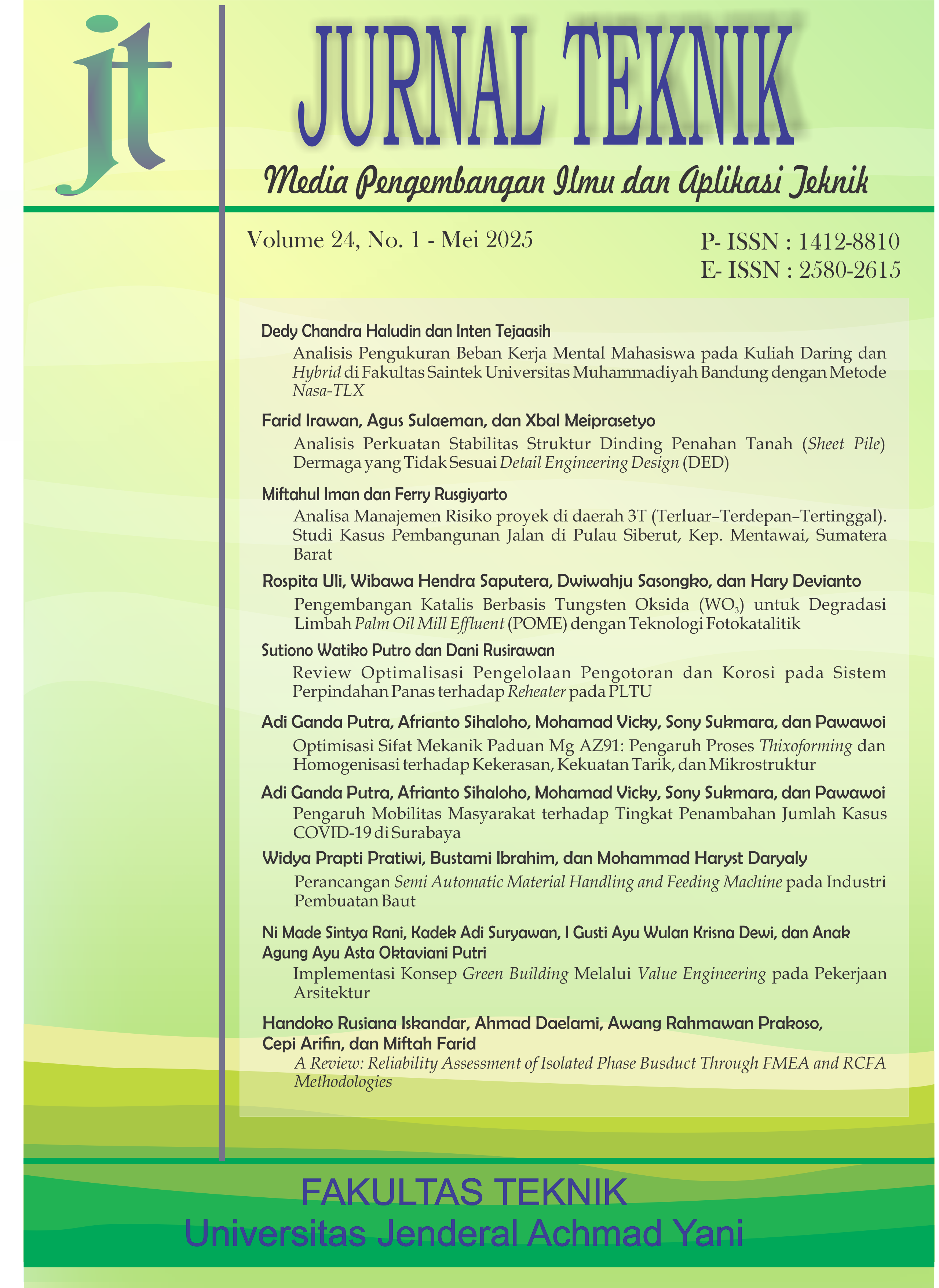
Implementasi Konsep Green Building Melalui Value Engineering pada Pekerjaan Arsitektur
DOI:
https://doi.org/10.55893/jt.vol24no1.730Keywords:
alternative, cost, green, materials, VEAbstract
Land use, energy efficiency and conservation, water conservation, material sources and cycles, indoor air quality, comfort, and building environmental management are the six facets of green building implementation, according to the Green Building Council Indonesia. These are based on the Green Ship tool for New Buildings version 1.2. Among other strategies, value engineering can be used to implement Green Building elements. Finding alternative material recommendations based on the Green Building concept that have the most cost-effective and efficient implementation costs during the architectural work execution phase is the aim of this study. Descriptive quantitative research methodology is employed, and pricing surveys and implementation method interviews serve as the main means of gathering data. The Budget Plan, Unit Price Analysis and timetable are secondary data that are utilized. Based on the analysis results, alternative material recommendations were obtained, namely for the Sumitra Hotel Project: ceramic walls, Aquashield wall paint, and ceramic floors. Whereas in the Magnum Residence Project, it is lightweight bricks. The alternative implementation costs for the Sumitra Hotel project for wall finishing work is Rp903,671,568 and for floor finishing work is Rp510,799,447. In the Magnum Residence Project, the alternative implementation cost for architectural work on wall finishing is Rp1,658,938,657.
References
Ainurrohmah, S., & Sudarti, S. (2022). Analisis perubahan iklim dan global warming yang terjadi sebagai fase kritis. Jurnal Phi Jurnal Pendidikan Fisika Dan Fisika Terapan, 3(3), 1. https://doi.org/10.22373/p-jpft.v3i3.13359
Amelia, H., & Sulistio, H. (2019). Analisis value engineering pada proyek perumahan djajakusumah residence. JMTS: Jurnal Mitra Teknik Sipil, 2(3), 209. https://doi.org/10.24912/jmts.v2i3.5831
Atabay, S., & Galipogullari, N. (2012). Application of value engineering in construction projects. 10th International Congress on Advances in Civil Engineering, October, 17–19.
Dinariana, D., Nurjaman, H. N., & ... (2021). Value engineering of architectural work in navalunit building planning, in west papua. Journal of Architecture and …, 6(9), 37–49. https://www.academia.edu/download/69367599/E06093749.pdf
Diputera, I. G. A., Agung, I. G., Putera, A., Putu, A., & Dharmayanti, C. (2018). Penerapan value engineering (ve) pada proyek pembangunan taman sari apartement. Jurnal Spektran, 6(2), 210–216. https://ojs.unud.ac.id/index.php/jsn/article/view/42315
GBCI. (2013). GREENSHIP RATING TOOLS GREENSHIP untuk BANGUNAN BARU Versi 1.2. April.
Hasan Busri, M. (2014). Analisis alternatif desain bangunan jembatan dengan value engineering. Extrapolasi, 7(1), 31–38.
Karim, D., Nasution, A., & Ashad, H. (2023). Rekayasa nilai pada bangunan auditorium gedung penunjang akademik politeknik ilmu pelayaran ( PIP ) salodong makassar. Innovative: Journal of Social Science Research, 3(3), 6422–6430. https://j-innovative.org/index.php/Innovative/article/view/2862
Kartohardjono, A. (2017). Analisis value engineering pada proyek pembangunan apartement di cikarang. Jurnal Konstruksia, 9(1), 41–58.
Kibert, C. . (2022). Sustainable Construction: Green building Design and Delivery, 5th Edition.
Kubba, S. (2010). Green Construction Project Management and Cost Oversight.
Munawir, R. (2021). Melawan dampak perubahan iklim dengan penerapan teknologi building information modelling/ BIM. Direktorat Jenderal Bina Konstruksi. https://binakonstruksi.pu.go.id/publikasi/karya-tulis/melawan-dampak-perubahan-iklim-dengan-penerapan-teknologi-building-information-modelling-bim/
Nandito, A., Huda, M., & Siswoyo. (2020). Penerapan value engineering pada proyek pembangunan puskesmas rego manggarai barat ntt. Jurnal Rekayasa Dan Manajemen Konstruksi, 8(3), 171–186.
Pratiwi, N. A. (2014). Analisa value engineering pada proyek gedung riset dan museum energi dan mineral. Institut Teknologi Bandung, 2(1), 166–170.
Ratnaningsih, A., Hasanuddin, A., & Hermansa, R. (2019). Penilaian kriteria green building pada pembangunan gedung IsDB project berdasarkan skala indeks menggunakan greenship versi 1.2 (studi kasus: gedung engineering biotechnology universitas jember). BERKALA SAINTEK, 2(VII), 59-66.
Suamba, D. P., & Nurdiantoro, E. (2014). Pembangunan berwawasan budaya di kota denpasar. Media Komunikasi FPIPS, 2(1), 1–08.
Sulistyawati, W., Wahyudi, & Trinuryono, S. (2022). Analisis (deskriptif kuantitatif) motivasi belajar siswa dengan model blended learning di masa pandemi covid19. Kadikma, 13, No. 1, 68–73.
Wau, N., Anurogo, W., Lubis, M. Z., & Ghazali, M. (2022). Dampak dan sekenario kenaikan tinggi muka air laut terhadap penutup lahan (studi kasus: kecamatan gunung kijang, pulau bintan). Jurnal Swarnabhumi, 7(1), 39-49.
Widyawati, R. L. (n.d.). Green building dalam pembagunan berkelanjutan. Program Studi Arsitektur Fakultas Teknik Universitas Borobudur.
Yusuf, M., Parwati, C. ., & Nasution, A. . (2021). Analisis rekayasa nilai lampu hias dalam usaha pengembangan produk. Jurnal Ilmiah Teknik Industri Dan Informasi, 9(2), 159–166.
Additional Files
Published
Issue
Section
License
Copyright (c) 2025 Ni Made Sintya Rani, Kadek Adi Suryawan, I Gusti Ayu Wulan Krisna Dewi, Anak Agung Ayu Asta Oktaviani Putri

This work is licensed under a Creative Commons Attribution 4.0 International License.
Authors retain copyright and grant Jurnal Teknik: Media Pengembangan Ilmu dan Aplikasi Teknik the right of first publication. Articles are published open access under the Creative Commons Attribution 4.0 International License (CC BY 4.0), which permits use, sharing, adaptation, distribution, and reproduction in any medium or format, for any purpose, provided that appropriate credit is given to the original authors and source, a link to the license is provided, and any changes are indicated.