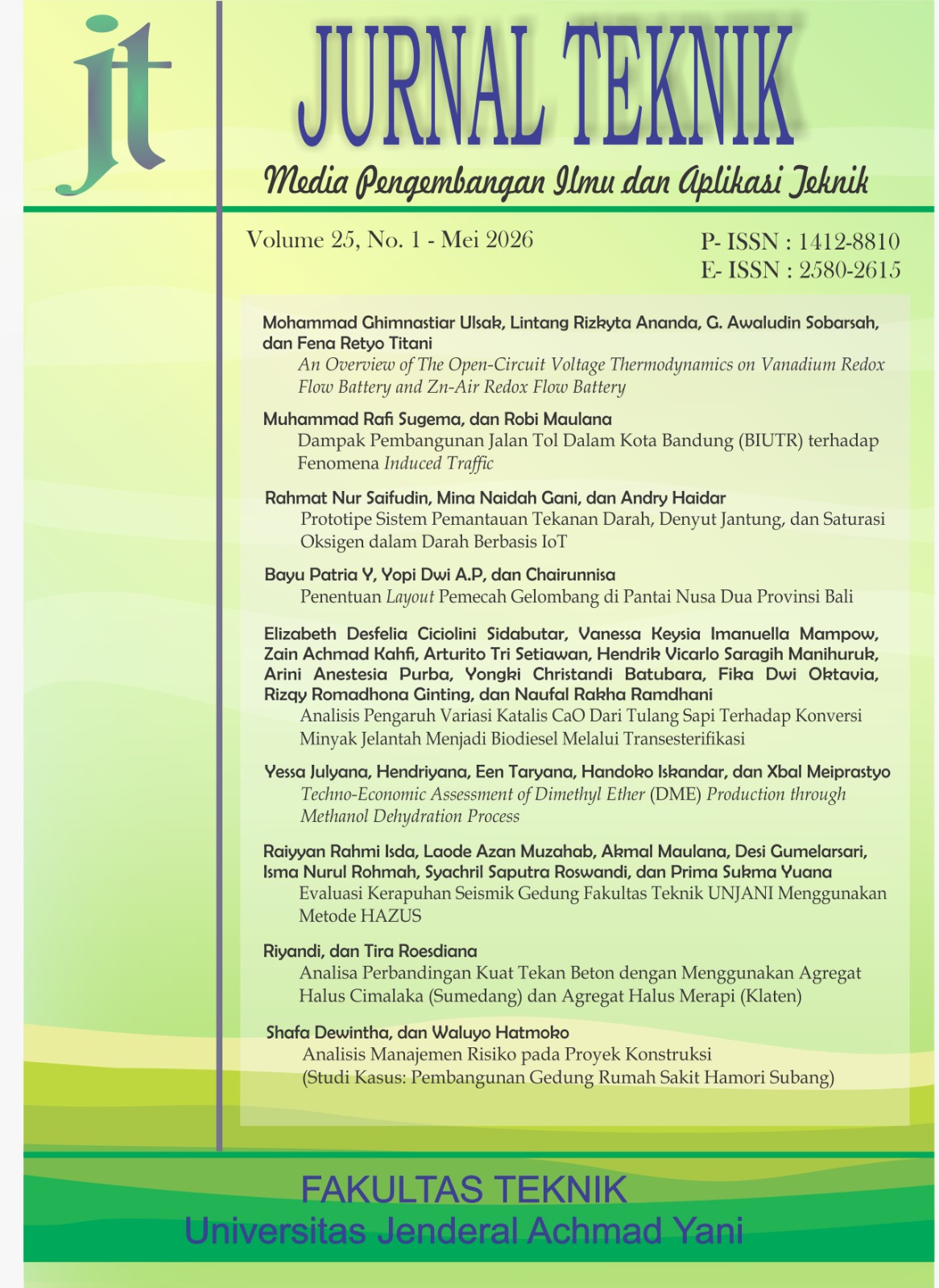
Evaluasi Kerapuhan Seismik Gedung Fakultas Teknik UNJANI Menggunakan Metode HAZUS
DOI:
https://doi.org/10.55893/jt.vol25no1.834Keywords:
seismic fragility, HAZUS Method, damage probability, pushover analysis, fragility curveAbstract
Seismic fragility assessment of educational buildings is important in Indonesia due to its high seismicity. This assessment is required to support risk mitigation and ensure the continuity of building function after earthquakes. This study aims to evaluate the seismic fragility of the Faculty of Engineering Building at UNJANI as an educational facility by integrating nonlinear static pushover analysis and the HAZUS Method. Using finite element-based software, the building was modeled three-dimensionally to obtain the capacity curve, performance point, and spectral displacement. The HAZUS method was applied to estimate the probability of damage states: slight, moderate, extensive, and complete. The results indicate that the building is classified as a mid-rise reinforced concrete moment-frame structure (C1M) with high seismicity level. Structural performance is at Immediate Occupancy in both the X and Y directions, indicating adequate capacity under the design seismic loads. Damage probabilities in the X direction are 0.0% complete, 10.0% extensive, 99.6% moderate, and 100.0% slight, while those in the Y direction are 0.0% complete, 16.0% extensive, 99.9% moderate, and 100.0% slight. Thus, the dominant damage is slight to moderate. Further research is recommended to consider dynamic analysis to strengthen the validation of the results.
References
American Society of Civil Engineers, & Structural Engineering Institute. (2017). ASCE/SEI 41-17 Seismic Evaluation and Retrofit of Existing Buildings. https://doi.org/10.1061/9780784416112.in
Ayuddin, & Bindhu, K. R. (2023). Application of Capacity Spectrum Method (CSM) for Non-Symmetrical Reinforced Concrete High-Rise Buildings As A Tool for Seismic Design. Sinergi (Indonesia), 27(3), 405–414. https://doi.org/10.22441/sinergi.2023.3.011
Badan Standardisasi Nasional. (2017). SNI 2052-2017 Baja Tulangan Beton. www.bsn.go.id
Badan Standardisasi Nasional. (2019a). SNI 1726-2019 Tata Cara Perencanaan Ketahanan Gempa Untuk Struktur Bangunan Gedung & Non Gedung.
Badan Standardisasi Nasional. (2019b). SNI 2847-2019 Persyaratan Beton Struktural untuk Bangunan Gedung.
Badan Standardisasi Nasional. (2020). SNI 1727-2020 Beban Desain Minimum dan Kriteria Terkait Untuk Bangunan Gedung dan Struktur Lain.
Badan Standardisasi Nasional. (2025). SNI 9273-2025 Evaluasi dan Rehabilitasi Seismik Bangunan.
Baylon, M. B., Sevilla, M. P. E., Cutora, M. D., Villa, R. S. M., Reynes, P. P. M., & Montemayor, J. V. M. (2022). Development of Fragility Curves for Seismic Vulnerability Assessment: The Case of Philippine General Hospital Spine Building. International Research Journal of Science, Technology, Education, and Management, 2(4), 1–11. https://doi.org/10.5281/zenodo.7559408
California Seismic Safety Commission. (1996). ATC 40 Seismic Evaluation and Retrofit of Concrete Buildings. In IEE Colloquium (Digest) (Vol. 1). https://doi.org/10.1049/ic:19990660
Diamantopoulos, S., Achmet, Z., Stefanidou, S., Markogiannaki, O., & Fragiadakis, M. (2024). Seismic Fragility Curves of RC Buildings Subjected to Aging. GeoHazards, 5(1), 192–208. https://doi.org/10.3390/geohazards5010010
Duan, X., & Pappin, J. W. (2008). A Procedure For Establishing Fragility Functions For Seismic Loss Estimate of Existing Buildings Based on Nonlinear Pushover Analysis.
Federal Emergency Management Agency. (2005). FEMA 440 Improvement of Nonlinear Static Seismic Analysis Procedures.
Federal Emergency Management Agency. (2022). Hazus Earthquake Model User Guidance (HAZUS 5.1). In Federal Emergency Management Agency (Nomor April).
Federal Emergency Management Agency. (2024). HAZUS Earthquake Model Technical Manual (HAZUS 6.1) (Nomor July).
Frans, R., Kalangi, H. T., & Goretti, H. A. (2021). Analisis Kerapuhan Seismik Struktur Beton Bertulang. JUTEKS : Jurnal Teknik Sipil, 6(1), 17. https://doi.org/10.32511/juteks.v6i1.719
Hasyim, W. (2025). Analisis Kerapuhan Seismik Struktur Gedung Tak Beraturan Dengan Analisis Pushover. Jurnal “MITSU” Media Informasi Teknik Sipil UNIJA, 13(1), 119–130. https://doi.org/10.24929/ft.v13i1.3741
Janous, S. El, Abid, M. A., Afras, A., & Ghoulbzouri, A. El. (2024). Soil-Structure Interaction Influence on the Seismic Performance of Buildings. Civil Engineering and Architecture, 12(2), 798–813. https://doi.org/10.13189/cea.2024.120210
Kementerian Pekerjaan Umum. (2024). Peta Sumber dan Bahaya Gempa Indonesia Tahun 2024.
Kohns, J., Stempniewski, L., & Stark, A. (2022). Fragility Functions for Reinforced Concrete Structures Based on Multiscale Approach for Earthquake Damage Criteria. Buildings, 12(8). https://doi.org/10.3390/buildings12081253
Kumar, A., & Ghosh, G. (2025). Assessment of Soil Amplification Effects on The Seismic Vulnerability of Irregular Reinforced Concrete Buildings of Varying Heights. In Scientific Reports (Vol. 15, Nomor 1). https://doi.org/10.1038/s41598-025-14145-2
Kuria, K. K., & Kegyes-Brassai, O. K. (2024). Pushover Analysis in Seismic Engineering: A Detailed Chronology and Review of Techniques for Structural Assessment. Applied Sciences (Switzerland), 14(1). https://doi.org/10.3390/app14010151
Maningding, R. A. D., & Baldo, J. N. S. (2024). Fragility Analysis of Pangasinan State University Urdaneta City Campus Buildings. WSEAS Transactions on Environment and Development, 20, 789–809. https://doi.org/10.37394/232015.2024.20.75
Muntafi, Y., Faraodi, R., & Asroni, A. (2018). Damage and Loss Probability Assessment of Reinforced Concrete Building Due To Yogyakarta Earthquake Scenario Using Pushover and HAZUS Analysis (Case Study : Student Center Building, Faculty of Social Science , UNY ). 02014. https://doi.org/https://doi.org/10.1051/matecconf/201822902014
Narwastu, A., Sangadji, S., Devi, R. H., & Safarizki, H. A. (2024). Analisis Kerapuhan Struktur Gedung Dinas Pertanian Kabupaten Pacitan dengan Static Adaptive Pushover. PADURAKSA: Jurnal Teknik Sipil Universitas Warmadewa, 13(1), 89–96. https://doi.org/10.22225/pd.13.1.7655.89-96
Nurhidayatullah, E. F., & Kurniati, D. (2021). Potensi Kerusakan Bangunan Bertingkat Sedang Dengan Skenario Gempa Lebih Besar Sama Dengan 5 SR Sebagai Upaya Mitigasi Bencana Di Yogyakarta. Teras Jurnal : Jurnal Teknik Sipil, 11(1), 125–139. https://doi.org/10.29103/tj.v11i1.409
Paudel, S., Maulana, T. I., & Prayuda, H. (2024). Seismic Vulnerability Assessment of Regular and Vertically Irregular Residential Buildings in Nepal. 10(May), 199–208. https://doi.org/10.22146/jcef.10316
Poudel, J., Khatiwada, P., & Adhikari, S. (2025). Seismic Performance Evaluation of Low-Rise Reinforced Concrete Framed Buildings with Ready-to-Use Guidelines (RUD-NBC 205:2024) in Nepal. CivilEng, 6(3), 1–23. https://doi.org/10.3390/civileng6030050
PT. Wijaya Karya. (2024). Shop Drawing Gedung Fakultas Teknik New UNJANI.
Pusat Studi Gempa Nasional (PuSGeN), & PPMB-ITB. (n.d.). Aplikasi Respon Spektra. Puslitbang Perumahan dan Permukiman. Diambil https://rsa.ciptakarya.pu.go.id/
Remki, M., & Kehila, F. (2018). Analytically Derived Fragility Curves and Damage Assessment of Masonry Buildings. Sustainable Civil Infrastructures, 42–54. https://doi.org/10.1007/978-3-319-61914-9_4
Rifki, M., & Teguh, M. (2019). Evaluasi Kerapuhan Seismik pada Struktur Gedung Kuliah Twin Building UMY Menurut SNI 1726-2012. Prosiding Kolokium Program Studi Teknik Sipil (KPSTS) FTSP UII 2019, 52–104. https://dspace.uii.ac.id/handle/123456789/13988?show=full
Sáenz, U., & Santana, R. (2023). Seismic Vulnerability in Essential Buildings Through Analytical Fragility Curves. 38, 319–333. https://doi.org/10.7764/RIC.00072.21
Sumedi, P. P., & Mulyandari, R. (2025). Kurva Kerapuhan Seismik Pada Struktur Rangka Baja Berbasis Pushover. Jurnal Rekayasa Teknologi Nusa Putra, 11(2), 93–102. https://doi.org/10.52005/rekayasa.v11i2.654
Zuher, M. H., Nasution, A. P., Sidiq, Z. N., Masrilayanti, M., & Tanjung, J. (2023). Fragility Assesment of Mid-Rise RC Building using HAZUS Method in High Seismic Zone. Jurnal Bangunan, Konstruksi & Desain, 1(2), 79–89. https://doi.org/10.25077/jbkd.1.2.79-89.2023
Additional Files
Published
Issue
Section
License
Copyright (c) 2026 Raiyyan Rahmi Isda, Laode Azan Muzahab, Akmal Maulana, Desi Gumelarsari, Isma Nurul Rohmah, Syachril Saputra Roswandi, Prima Sukma Yuana

This work is licensed under a Creative Commons Attribution 4.0 International License.
Authors retain copyright and grant Jurnal Teknik: Media Pengembangan Ilmu dan Aplikasi Teknik the right of first publication. Articles are published open access under the Creative Commons Attribution 4.0 International License (CC BY 4.0), which permits use, sharing, adaptation, distribution, and reproduction in any medium or format, for any purpose, provided that appropriate credit is given to the original authors and source, a link to the license is provided, and any changes are indicated.